
UNIVERSAL CHILDREN’S DAY CELEBRATES OUR YOUNGEST CITIZENS

Universal Children’s Day
By Nic Halverson
Mercy Home for Boys & Girls is all about improving the welfare of children in need — it’s our number one priority. Our safe, nurturing home helps kids heal from years of abuse and neglect, so they can go on to lead healthy, productive lives.
That’s why, today, we celebrate Universal Children’s Day — a day to promote international awareness and togetherness in effort to improve the lives of children the world over. This days encourages children of different backgrounds to spend time together and appreciate each other’s differences. The day also urges governments to pay closer attention to the welfare of their youngest citizens.
Founded by the United Nations in 1954, Universal Children’s Day offers an inspirational point of entry to advocate and promote children’s rights. Hopefully, these initiatives spark conversations and actions that lead to a better future for children.
So, take time today to celebrate the children in your life and do something special with them — maybe a trip to their favorite museum, the zoo, or their favorite playground.
Or, consider a truly meaningful action that will leave lasting impact by donating to Mercy Home for Boys & Girls.
Transporting Hope: SOS Illinois’ Charitable Fundraiser Gathers Industry Leaders to Support Children in Foster Care
Evening of Hope is the annual fall fundraising event for SOS Children’s Villages Illinois. The funds raised from this event play an incredibly important role in the wellbeing of the children and families we serve, and this year was no exception. Check out the photos of this event at the end of this article!

Evening of Hope 2019 VIP Honorees and Committee Members gathered with SOS Illinois leaders
About Evening of Hope 2019
Held on Thursday, October 10 at the Museum of Contemporary Art in Chicago, Evening of Hope was a celebration of innovation, community, and hope. The event honored the builders and visionaries who keep SOS Illinois charged to continue breaking new ground in Illinois foster care through charitable works of giving and awareness-raising. Over 600 guests enjoyed the street food carving stations, cocktails, silent auction items, DJ R3DLINE, and the incredible museum exhibits featured at Evening of Hope 2019.
VIP Reception Brings Together Illinois Industry Leaders
Leaders in the transportation industry joined board members and sponsors for a special reception prior to the main event that highlighted the important work of SOS Illinois. Evening of Hope 2019 VIP Honorees included: José Alvarez, Illinois Tollway Executive Director; Jamie Rhee, Chicago Department of Aviation Commissioner; Rocky Donahue, PACE Executive Director; Omer Osman, Illinois Department of Transportation Acting Secretary; Bruce M. Marcheschi, METRA Chief Operating Officer and Deputy Executive Director; and Retired Judge Gloria Chevere, Chicago Transit Authority Board Member. Each VIP Honoree shared inspirational remarks on their dedication to the services provided by SOS Illinois.
Welcomed by Board President Jim Wolfe, attendees were thanked by Event Chair and Board Vice President John Trotta who shared, “I am so proud to be in this industry . . . you are amazing, and when you are downstairs you’ll see there are going to be 500-600 people here who care about our kids . . . To see the kids graduate, to see the difference we collectively have made is amazing.”

José Alvarez
VIP Honorees Share Wisdom and Commitment of SOS Illinois’ Mission
José Alvarez, Illinois Tollway Executive Director, who first learned of the SOS Illinois mission during his time at the Chicago Housing Authority, started by discussing Casa Tepeyac, the site in the Back of the Yards Neighborhood, and how he remembered the vacant lot before the facility was built, “The kids that benefit from this, the families that benefit from it, these are the same families I grew up around. These are the same kids I went to high school with. And these are the same kids that may be going to school with my kids. Thanks to organizations like yours, you help kids actually make it home . . . this is a real organization making a real difference for people.”

Jamie Rhee
Jamie Rhee, Chicago Department of Aviation Commissioner shared that she is a DCFS Foster Parent and has been caring for her child since she was 18 months old. She continued, “We owe it to the generations coming to make sure we are providing the best environment for them to succeed . . . we have a vested interest in creating that pipeline for the next generation . . . and that starts with each and every one of us, in this room, every day to say how do we make the north and the west and the south sides of Chicago equal. How do we give equal access to jobs and opportunities and businesses to grow and flourish and be diverse. These kids deserve it.”

Rocky Donahue
Rocky Donahue, PACE Executive Director remarked, “all of you in this room, be it the staff at SOS (Illinois), or the board, or those volunteers, you’re the real honorees . . . this organization does meaningful work that changes children’s lives and families’ lives.” He then continued, “This organization is kind of like PACE. We’re all in the infrastructure business, and we’re all taking individual lives and bringing them into a bigger and broader community and making that community better. What SOS (Illinois) is doing by changing those (children’s) lives and making them a part of the bigger community is really inspirational. As a person who serves the public, and now seeing how well SOS (Illinois) does, just imagine how great our world could be if we could do this the same way.”

Omer Osman
Omer Osman, Illinois Department of Transportation Acting Secretary started by talking about his family of eleven brothers and sisters and how his dad worked to ensure each one attended college. He then shared, “This organization is an international organization. What this organization does is make an immediate impact not only on the individual, but an impact on the family. A whole family, and by extension, a Village. This work is important, I’m so proud to be a part of it.”
Bruce M. Marcheschi, METRA Chief Operating Officer and Deputy Executive Director continued, “There is nothing more important than that strong bond of family. Every child deserves that. Every child deserves an opportunity. Without that, I think you mentioned the future, there is no future. We’re the roadbuilders of their future, so to speak. We need to get them there. Without the support in this room, and the love and the generosity in this room, we wouldn’t have what we have today. And we can’t let this mission falter, we need to keep it going.”
Retired Judge Gloria Chevere, Chicago Transit Authority Board Member, spoke “These words are not only mine, I also have the honor of speaking on behalf of the President of the Chicago Transit Authority, Mr. Dorval Carter, who could not be here today, but he absolutely wanted to be here. I’m thrilled to be here tonight.” She furthered,” SOS (Illinois), the work you are doing to help kids in our community is vital to the future success. I’m thrilled to hear of your 100% graduate rate. Your organization offers them, us, and our community hope . . . I know it makes a difference.”
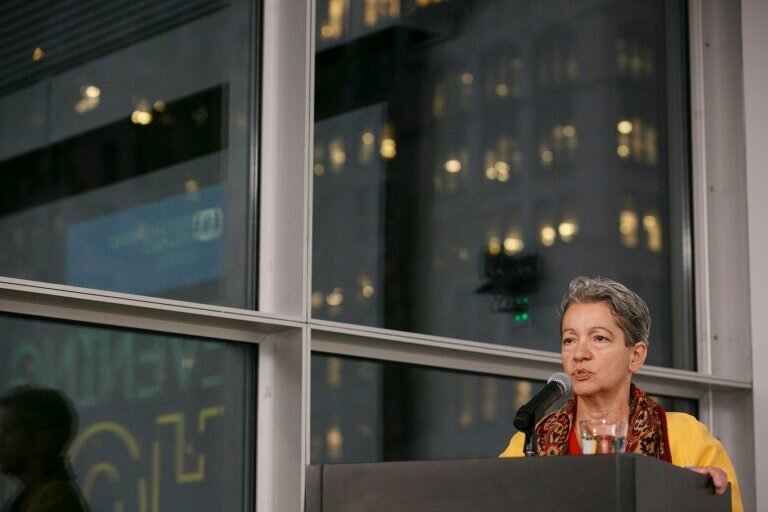
Judge Gloria Chevere
With that, Tim McCormick, CEO of SOS, Illinois closed the reception with two parting comments, “We have one common story, the stories we heard from each of our VIPs. It’s not about the struggle, it’s about where we go with the hope to get there . . . and the second thing is, we will gather and continue to do this. This is a story worth telling. It gives us hope, as many of us heard, not only for the children and families, but also for our society; and this is what Evening of Hope is about.”
Evening of Hope and Helps Children in Foster Care Flourish
The funds raised at Evening of Hope are crucial in helping SOS Children’s Villages Illinois continue to provide high-quality, exceptional programs and services to children in foster care. At SOS Illinois, our model of care is uniquely different than that of traditional foster care, and we are proud and honored to be able to bring that awareness to Evening of Hope. We are committed to providing safe, stable, and loving homes for children in foster care in Illinois, as well as providing preventative services to at-risk families. Our model of care allows us to keep brothers and sisters together in an individual home in the care of a full-time, professional Foster Parent. In doing so, we lay the foundation for rebuilding trust, confidence, and hope for each child in our care. As a result of this model, we annually celebrate a 100% high school graduation rate compared to the national average of only 50% of youth in foster care.
Evening of Hope 2019 Photos
Professional photos from this event are available for download. Don’t forget to tag us as @sosillinois on Instagram and @soscvi on Facebook when sharing them with your friends! Enter PIN 9669 to download.
Committed to Charitable Giving in Chicago
Evening of Hope is generously supported by both individuals and corporate partners committed to investing in a local charity in Chicago. You can check out the fundraising events full list of sponsors, and learn how you can get involved in building the future of foster care.
The Mental Health Impact of Family Separation
AFFIRMATIONS Spring 2019
A publication of the Jane Addams College of Social Work, University of Illinois at Chicago
The policy of separating children from migrant families at the U.S. border brought the issue of family separation into the national conversation.
As social workers, we are already familiar with the negative mental health impacts for children who are forcibly separated from their parents; we have long seen the consequences for children in the child welfare system.

Professor Sonya Leathers
In the summer of 2018, national attention became focused on migrant children who were separated from their families at the U.S. border. The policy of mandatory family separation was short-lived, but as of January 2019 there were an estimated 10,500 unaccompanied minors in detention centers in the U.S. Many of these children will not be reunited with family, and some are likely to go into foster care.
Professor Sonya Leathers, drawing on her experience with attachment and trauma among children in the child welfare system, observes that there are always mental health impacts for children who are separated from their primary caregivers. She notes that trauma will vary with the age of the child, their particular developmental needs, current or past stresses, and by how the separation is handled.
“But, in the situation at the border there has been a lack of attention to the needs of the children and how very vulnerable they are,” she says. “Their parents and siblings have really been their lifeline, not just at the moment of separation but also because they’ve been through enormous challenges up to that point. And then to have that lifeline abruptly separated...I fear there will be an enormous mental health impact.”
Assistant Professor Jennifer Geiger agrees, observing that even if a migrant family is fleeing violence or extreme poverty, the children have still felt safety and security in being with a parent or caregiver. She compares this to what she’s seen with children in the child welfare system. “Children fundamentally wish to stay with their parents and their family, even though home life may be abusive or neglectful. It might have been the worst situation you can imagine, but the child will almost always say they want to be back with their family,” she says. “So, working with and supporting the family and keeping the family intact is the desired outcome for the child’s mental health and well-being.”
For cases in which removal of the child is recommended, Dr. Leathers says that child welfare practitioners have been working toward a system of care that attends to the attachment needs of the child. Ideally, the trauma of separation is lessened by making sure the child understands the circumstances and understands that they will continue to have a connection to their parent. “We know from child welfare studies and practice that children fare much better when the separation is more gradual,” she says. “It’s helpful if they are able to go with the parent to their new home, and to know that the parent is involved in that decision.”

Assistant Professor Jennifer Geiger
Dr. Geiger explains that for children entering the child welfare system, the trauma of separation from family can stem from many variables, such as the allegations against the parent, who is present when the separation occurs, the age of the child, the relationship between the child and caregivers, how the adults in the situation are responding, or whether it happens at home or elsewhere. “There is always some degree of trauma as a result of the separation,” she says. “In some cases, children may develop traumatic responses to professionals who are present at the time of removal.”
Geiger worries that with the separations at the U.S. border, neither parents nor children had time to prepare. “Plus, there’s the involvement of military or law enforcement, and the presence of weapons. All of this increases the trauma,” she says. “In separating these children from their families and placing them in institutional care, it really seems as if policymakers are not considering the long-term impacts to the children.”
Dr. Leathers observes that in child welfare, children and teens are placed in an institutional setting only after an in-depth review process, to ensure it is required to meet the child’s treatment needs. “Placement in group care usually occurs only when the child has intense physical or mental health needs that cannot be met by being placed in foster care,” she says. “And when they are placed in a group setting, we hope to make the stay as short as possible.”
Dr. Geiger adds that with children who are placed in an institutional setting such as congregate care, the trauma may become further complicated. “Research shows that this is not the best environment for kids, especially if they have higher needs. In this setting there’s more instability and staff turnover,” she says, “so it’s harder for the children to form relationships with their adult caregivers.”
Geiger notes that the child welfare system is moving away from placing children in institutional care. “With the passage of the Family First Act, there will not be as much funding for those types of placements, and this will be a real shift in how we practice child welfare,” she says, “but the goal has always been to balance the safety and well-being of the child with minimizing trauma and the resulting mental health issues.”
For the migrant children who were placed in detention centers or shelters, Leathers says that it’s hard to know what sort of care the children are receiving. “Care providers working in the shelters are probably well- meaning and want to provide the best care they can, but they are probably overwhelmed by the numbers of children,” she says. “And we don’t know how many of the children are receiving trauma-informed care.”
Even when children are reunited with their families, the process of reunification may be difficult. “We know that severing the attachment between parent and child is traumatizing, and trying to mend that is extremely difficult. Reattachment doesn’t happen automatically,” Geiger says. “We see this in the child welfare system, and social workers need to play a role in the process, helping to mend the relationship and the psychological and emotional trauma.”
“ There is always some degree of trauma as a result of the separation.
In some cases, children may develop traumatic responses to professionals who are present at the time of removal.”
“For the mental health of the children, the surest remedy is prevention, making sure that families are not separated to begin with,” adds Dr. Leathers. She says that among families entering the child welfare system, there is typically a significant level of need, making it difficult for case workers to address the various needs of the parents and the children. “I would love to see a system that puts as much effort and investment into strengthening those families and making sure that parents are well- equipped from the time they have a child,” she says.

Assistant Professor Christina DeNard
Assistant Professor Christina DeNard, whose research focuses on improving services for families in the child welfare system, is in complete agreement. “From the literature, we know that families encountering the child welfare system already have risk factors. Once they’re in the system, the interventions are individual, it becomes an individual issue, and the onus is on the individual or the family,” she says. “We need to support families before they enter the system. If we invest in our communities, we can see a lot of difference in terms of families flourishing.”
This article was printed in the UIC Jane Addams School of Social Work Spring 2019 Edition of “Affirmations”.
How Evening of Hope Makes a Difference at SOS Illinois
Evening of Hope is the annual fall fundraising event for SOS Children’s Villages Illinois. The funds raised from this event play an incredibly important role in the wellbeing of the children and families we serve here, and this year is no exception. We are absolutely ecstatic to be able to not only raise awareness for children in foster care at Evening of Hope 2019 but to also highlight the dedicated work that has gone into creating the Roosevelt Square Community Center – a center that will not only serve the over one hundred children and families cared for at SOS Illinois, but also more than 5,000 people from the surrounding neighborhoods.
About Evening of Hope 2019
Held on Thursday, October 10 at the Museum of Contemporary Art, Evening of Hope is charged with the power of an innovative future for children in foster care and families served by SOS Illinois. Featuring an array of artfully prepared hor d’oeuvres, desirable silent auction items, cocktails and drinks prepared for guests, a DJ spinning music, and an exciting raffle, Evening of Hope 2019 is sure to please sponsors and attendees alike. A list of notable VIPs will soon be shared on our Evening of Hope page; check back often to make sure you stay up to date!
Evening of Hope 2019 Highlights Roosevelt Square Community Center
On June 11, ground broke at our Roosevelt Square Community Center. This year, Evening of Hope will be highlighting the innovative construction phase of the center, celebrating the electrifying and support of our partners, donors, and friends. The Roosevelt Square Community Center will serve the children and families in our Roosevelt Square Village and the surrounding communities, helping expand and enhance the services currently offered. Programs at the center will include academic, therapeutic, social, and recreational support. The center will also feature multi-use spaces for community members to connect to public resources and engage in training, activities, and events; as well as a signature culinary kitchen that will provide food and nutrition education as well as jobs-skills training for the hospitality industry.
Join Us for Evening of Hope and Help Children in Foster Care Flourish
The funds raised at Evening of Hope are crucial in helping SOS Children’s Villages Illinois continue to provide high-quality, exceptional programs and services to children in foster care. At SOS Illinois, our model of care is uniquely different than that of traditional foster care, and we are proud and honored to be able to bring that awareness to Evening of Hope. We are committed to providing safe, stable, and loving homes for children in foster care. Our model of care allows us to keep brothers and sisters together in an individual home in the care of a full-time, professional Foster Parent. In doing so, we lay the foundation for rebuilding trust, confidence, and hope for each child in our care. As a result of this model, we annually celebrate a 100% high school graduation rate compared to the national average of about 50% of youth in foster care.
Your participation in Evening of Hope will help us provide our youth true healing, growth, and personal achievement, among other important areas of development for children and families. You may purchase your tickets or sponsorships to Evening of Hope 2019 at this link.
Don’t forget to share this event with others to help bring awareness to the unique opportunities that will help shape the lives of so many wonderful children in foster care here at SOS Children’s Villages Illinois.
Akiem Hicks, Chicago Bears Defensive Lineman, Visits SOS Childrens Villages Illinois
Thrilling energy filled the atmosphere of SOS Children’s Villages Illinois’ “Tailgate Tuesday” on September 10, 2019. In celebration of the beginning of another academic year, SOS Illinois staff, Foster Parents, children, and volunteers gathered on the green space of the Chicago Village for an afternoon jam-packed with football-themed activities, tailgate treats, and plenty of laughter. Among the buzz was the anticipation of the arrival a special guest who would be paying to our unique Illinois foster care agency: Chicago Bears’ Akiem Hicks.
SOS Illinois Welcomes Akiem Hicks with Open Arms and Cheers
As the gathering awaited the appearance of the Chicago Defensive Lineman, participants filled up their time with plenty of outdoor fun. With the help of volunteers from T-Mobile and PHMG, children enjoyed special games, an “inspiration station”, a table full of crafts, exploration of the community garden, and snacks from the “concession stand.” Despite being filled with energy, the group grew attentive and quiet when the announcement was given that Hicks was making his way down to the re-created football field spray-painted on the grass, complete with a 15-foot high homemade field goal post, where the celebration was being held.
As Hicks strolled up to the sea of children ringing cowbells and holding signs decked-out with his jersey number, parents and staff members snapped quick photos and joined the children in cheers. High-fiving members of the gathering as he passed, Hicks greeted SOS Illinois families with a supportive speech and a wide smile.
Akiem Hicks Offers Wisdom to our Youth
“To me, preparing for the school year is similar to gearing up for a game. You have to get ready, set goals, and stay focused,” Hicks said, joined by his supportive mother, Desiree. “Success on the field or in the classroom is where preparation and opportunity meet.”
Desiree, beaming as she watched her son speak, was praised by SOS Illinois Chief Executive Officer, Tim McCormick, as he introduced her and called her up to the front of the group. McCormick explained that SOS Illinois understands the importance of a supportive caregiver. Sharing in the sentiment, Hicks expressed that he would not be where he is today without the support and love he receives from his mother, whose influence is the reason he feels the need to give back and care for his fellow teammates and communities.
One of those fellow teammates on the Bears, wide receiver Riley Ridley and his older brother, Falcons wide receiver Calvin Ridley, spent a portion of their childhood at SOS Children’s Villages Florida. Seeing major success stories such as these, paired with the encouragement of idols such as Hicks, plays a major part in sparking ambitious spirits in children as they look toward a hopeful future.
“Children in foster care really don’t have a voice,” said McCormick to members of the press. “Often, in the education system, the healthcare system, even in communities, children don’t know some of the things that have been going on, and they feel invisible. When someone like Akiem Hicks of the Chicago Bears comes here, these children realize, ‘Wow, we really are something, and people do care.’”
We’re fortunate that this is not the first time the children at SOS Illinois have enjoyed the support of Chicago Bears athletes. Previously, Anthony “Spice” Adams, former Chicago Bears Defensive Tackle, joined our community to lend his support for foster care in Illinois by running the “Magic Minute” for us to gather gifts for children and families in our care.
Hicks Gifts the Children with Backpacks and Hope
After Hicks’ speech to the children, he was presented with a signed football with every child’s name. He, then, graciously gifted each child with a new backpack to help make the new school year a great success. It was then Hicks’ to join the fun. Activities included Hicks practicing football moves on the faux field with the children, coloring with the younger youth at the inspiration station, and participating as judge of the “touchdown dance competition” hosted for a prize. Each child enjoyed their time with Hicks, many mentioning that it was the most exciting time of the summer season.
Gratitude for Akiem Hicks and the Chicago Bears
We are immensely grateful for the support, empowerment, and kindness of Akiem Hicks and the Chicago Bears team, as well as for the hard work of the Tailgate Tuesday volunteers from PHMG and T-Mobile. Together with your support, we are creating stronger futures for youth in foster care, inspiring the next generation of leaders on – and off the football field.
Get Involved with SOS Illinois in Honor of Akiem Hicks
Feeling encouraged to get involved with our organization? Find your perfect fit at Becoming a Foster Parent, Careers & Internships, Volunteers, or Giving!
MercyWorks & the 2019 Chicago Marathon
CALLING ALL MARATHON RUNNERS!!!
You can be a Hero to children in need by running the 2019 Bank of America Chicago Marathon for Mercy Home. With every step you take, you'll help give abused, neglected, and abandoned children a safe, loving home.
Our Heroes are an integral part of the Mercy Home family because they literally work miracles in the lives of our kids. Because of their dedication, they make it possible for our kids to learn all the necessary skills to succeed both in school and in life. We hope you will consider joining the ranks of those who make this possible!
You can do it...and we'll help
As a member of the Mercy Home Heroes team, we'll make sure you have everything you need to reach the finish line.
Guaranteed Race Entry
Don't take your chances in the drawing. Secure your spot in the sold-out Chicago Marathon by signing up today with the Mercy Home Heroes. *
* $1,750 fundraising minimum before close of the drawing.
Free Training with CARA
CARA has helped tens of thousands of runners complete 26.2, including thousands of charity team runners. If your goal is to complete the marathon in Chicago, CARA’s 18-week program has long been Chicago's premier group training program, serving newcomers and experienced runners alike. Learn More
Team Events
Learn more about the kids at Mercy Home and get to know your fellow team members with a pre-race pasta dinner, post-race victory party, and team get-togethers throughout the year.
Exclusive Gear
Show everyone that you’re making a difference for the kids with our brand-new race-day singlet and tee.
Fundraising Support
We’ll give you everything you need to reach your goal, including your own fundraising web page.
Cheer
You’ll get a Hero’s welcome from Mercy Home coworkers, kids, friends, and family as you pass our campus at the Mercy Mile.
Please visit the Heroes Helping Kids homepage for more information and to donate today!
Mass Incarceration: Punishing the Families

AFFIRMATIONS Spring 2019
A publication of the Jane Addams College of Social Work, University of Illinois at Chicago
In America’s era of mass incarceration, a startling number of families experience the deleterious impact of the imprisonment of a family member. More sensible public policies are needed to address this crisis.
The U.S. Bureau of Justice Statistics estimates that at year-end 2016 there were 6.61 million persons under the supervision of U.S. adult correctional systems, and 2.16 million persons under the jurisdiction of state or federal prisons or in the custody of local jails. While very high, these figures actually represent a trend of decreasing incarceration since 2007.
However, the United States still claims the dubious distinction of leading the world in the imprisonment of its citizens. Our unmatched levels of incarceration have not resulted from increasing crime, but from more punitive policies and practices, such as the war on drugs, three strikes laws, truth in sentencing laws and overzealous prosecution. Further, these laws have disproportionately impacted low-income families and communities of color.
Given how many people have been incarcerated, there is shockingly little conversation about the impact on their families. When a person is imprisoned, their family usually carries a tremendous burden, but they have been forgotten in the apparent rush toward more punitive policies, and a permanent focus on the prisoner and the offense.
When the Incarcerated Person is a Parent
Assistant Professor Branden McLeod has examined the relationships incarcerated fathers have with their children and family. He observes that children experience ambiguous loss when a parent is incarcerated; the parent is not permanently gone, but is missing from the child’s daily experience, and the parent’s identity and family role have been significantly altered. Further, the child’s access to the parent becomes very limited, a situation made worse when the parent has a longer sentence or if visitation is not possible. “Without regular contact with the parent, it’s hard for children to reconcile their emotions about that person,” observes McLeod. “We have to help families maintain those roles and identities in order to maintain healthy relationships.”

Assistant Professor Branden A.McLeod, PhD
To accomplish this, he says there need to be more family-centered policies and programs to keep children connected with incarcerated parents. “There have been successful programs for this, but they tend to rely on volunteers from outside the prison,” says McLeod. “We need a serious nationwide commitment to preserving families, including robust visitation policies and supportive programs for family reunification.”
McLeod’s research has explored the impact of incarceration on paternal involvement, how fathers can be resilient once they reenter society and how they can reconnect and reestablish certain roles within their family. He has found complex relationships between fathers’ engagement, accessibility and responsibility with their children, including the role of co-parenting in mitigating impacts and improving outcomes for the children. He has also conducted a father and son study to examine the effects of paternal incarceration on educational outcomes for the son.
McLeod hopes his research will contribute to informing effective and supportive public policy. “Generally, there are not positive outcomes from incarceration; it’s merely punitive and doesn’t address underlying issues that exist in so many of our communities,” he says. “It costs about $40,000 per year to incarcerate someone which, again, doesn’t accomplish much and has so many deleterious effects.” He points to the dissolution of families, the mental health impacts on children, how many of the children end up in the child welfare system and, longer-term, the impacts on childrens’ educational and employment outcomes. “The money spent on incarceration needs to be reinvested in programs that keep families together and improve outcomes for the children,” he says.
The money spent on incarceration needs to be reinvested in programs that keep families together and improve outcomes for the children.
While mass incarceration has overwhelmingly impacted men, especially men of color, the rate of incarceration of women is increasing. “Women make up approximately 10% of the prison population, but the number is growing,” adds Assistant Professor Aaron Gottlieb. “Women are more likely to be incarcerated for nonviolent offenses, are almost always victims of violence or sexual assault, and are more likely to have substance use issues. And more than 50% of these women are mothers.”
He observes that issues around the incarceration of women and mothers is under-discussed because of the relatively low numbers compared to men. “But prison doesn’t make the most sense for women,” he says, “not only because of the impact for children, but also because women’s prisons tend to have less programming than men’s prisons, fewer employment or education programs, and inadequate reproductive healthcare.”

Assistant Professor Aaron Gottlieb, PhD
Gottlieb’s research examines factors that bring women into the criminal justice system, and factors that keep them trapped in the system. For example, he studied the impact of eviction on criminal justice involvement for mothers in the U.S., and the data suggests that mothers who have been evicted have more than two times higher odds of experiencing criminal justice involvement. “Additionally, a system of money bail or money bond disproportionately impacts women,” Gottlieb says. “Twenty-eight percent of women behind bars are simply awaiting their trial, but are unable to pay the bail. People wait weeks or months, and in some cases years for their trial. This can have serious consequences for the family.”
Returning to the impacts on children, Gottlieb points to mental and physical health issues and higher risk for juvenile or criminal justice involvement. “Incarceration of a parent can also impact the resources children receive,” he says, referencing a study he co-authored with McLeod examining the impact of parental incarceration on child support arrears. Their study found that incarceration is a predictor of fathers’ accrual of child support debt. “When child support arrears pile up,” he says, “it adds additional stresses to family relationships.” McLeod adds, “The debt may become a further barrier to successful reentry and reintegration for the father. This again highlights the importance of policies that focus on the well-being of the family.”
The Further Impact on Families and Communities

The impact of incarceration on the families of prisoners has long been a focus in the work of Dean Creasie Finney Hairston. She explains that, while children are perhaps the most vulnerable members of the family, the impacts may be felt by spouses, partners, parents, siblings and cousins, and can extend beyond the family into the community. She notes that the impact on families may be financial, social or emotional.
Financial Impact
Dean Hairston notes that families become strained when the incarcerated person had been contributing financially. “Regardless of whether it was a legal job, income ‘under the table,’ or even from illegal activity,” she says, “that income is now gone and the family suffers. Imagine the impact to a family that was already struggling financially prior to the incarceration.”
In addition to potential lost income, she points to a variety of costs that may burden the family, costs that are often unanticipated. There can be legal costs such as counsel, appeals or sentence reduction. Maintaining a family relationship can bring a number of additional costs, including telephone calls from within the prison, which carry exorbitant fees. Families also bear the cost of visits to the prison. “Visiting an incarcerated family member may require substantial travel, since state prisons are often in remote areas, and a person in federal prison may be in a distant state. And traveling requires food and lodging,” Hairston says. “Even video visitation has costs associated with it. It can get very expensive for families trying to maintain a relationship with an incarcerated individual.”

Dean Creasie Finney Hairston
There are also financial costs of supporting and maintaining an incarcerated person. “ Even if the person has a job in prison, the pay is very low,” says Hairston. “So when there are things that they need or want – an extra pair of shoes, money for the commissary, books, magazines or art supplies – a family member or friend has to send the money or send the item. It all adds up. The combination of lost income and increased expenses can plunge a family into poverty.”
Social Impact
The social costs to families are very real and very practical, yet rarely recognized or discussed by academics or policymakers. “Social costs are more to do with the absence of that person from the home, and what it means for the family,” says Hairston. “What was the person’s role in that family? Whatever it is or was, that is now disrupted. That relationship has now changed.” She cites as examples life situations that may be taken for granted until a person is removed from the family. “Is the incarcerated person the one who picked the kids up from school? Were they the one who changed the light bulbs in the high ceilings? Such things might seem insignificant,” she says, “but can have a cumulative impact on family life.”
People may also experience stigmatization simply for having a family member in prison, or for being related to someone who committed a crime. “Often, whatever that person did to be imprisoned, the perception is transferred to his or her family members,” says Hairston. “If you’re the mother, people may think ‘How did you raise that person?’ Or if you’re a partner, ‘Why are you maintaining contact with that awful person?’ This overlooks the important fact that the incarcerated person is more than their worst deed. They are a father, a sister, a son or a brother.”
Hairston also points to the common perception that in communities with high rates of incarceration, there is no stigma attached to being incarcerated. She explains that it may depend upon the particular offense. For example, being sentenced for selling marijuana may be seen as acceptable, whereas shooting an infant in a drive-by or mugging and beating an elderly woman would be viewed very negatively. “The family must deal with what people think about the crime and about them. How do you protect your kids from this, while also being supportive of the family member who may have done something really bad,” she asks. “It’s very complicated and can be a difficult balancing act for the family as they struggle to maintain some sense of stability or normalcy.”
Finally, there are the social costs that incarceration has exacted on entire communities. When large numbers of people (most often men) are removed from the community, many social relationships become disrupted which, in turn, impacts the social ecology. There is a ripple effect that moves throughout the community. For example, the incarceration of a parent may contribute to children acting out in school. Schools may respond by enforcing zero-tolerance policies, punishing even small infractions. Many such children will end up in special education, with an increased likelihood of contact with the juvenile justice or criminal justice systems.
Emotional Impact
Having already experienced the stress of an arrest, the wait for the trial and then the trial itself, families are further taxed emotionally during the incarceration, especially if they are trying to maintain a relationship with the person in prison. There is the obvious emotional cost of just knowing that the family member is in prison, or seeing them in that environment. But there can be additional costs, such as going to a parole hearing only to hear that parole is denied. “There is an uncertainty that is very stressful for the family,” says Hairston. “They never know what’s going to happen, at trial or at a parole hearing. Or even on a visit, when they arrive at the prison but it’s on lockdown, so they’re prevented from seeing the family member.”
“A prisoner’s life is no longer his or her own, but neither is the life of the family. There are so many things over which they have no control. Someone else makes all the decisions, exercising a kind of control over their lives. It creates a lot of uncertainty and stress for the family.”
She goes on to explain that this is why families so often say it feels as if they are doing time, that they are being punished. “A prisoner’s life is no longer his or her own, but neither is the life of the family. There are so many things over which they have no control. Someone else makes all these decisions, exercising a kind of control over their lives,” she says. As an example, when on a visit, the treatment families receive from prison staff can make them feel as if they are prisoners. “The dress code for visitation can vary not only from prison to prison, but also from day to day at a single prison, depending on who is processing,” says Hairston. “It creates great uncertainty and stress for the family.”
There are also emotions around the loss of the person from family life. People may experience grief for the loss of their incarcerated family member, but the experience is different from when someone has died. “When someone in the family dies, there is a funeral and a eulogy saying nice things, and people bring food and they grieve with you,” Hairston says. “But when someone goes to prison, you grieve alone, you don’t get that support.”
Costs Continue Even After Community Reentry
Most incarcerated people do return to the community and, while this is generally the desired outcome, there are still costs and difficulties for the family. Dean Hairston points to practical costs such as supporting the person while they seek employment. “
Formerly incarcerated people face many obstacles to finding and keeping gainful employment. Movements like Ban the Box are making some progress, but supporting the person as they struggle to find employment can add substantial financial difficulty for the family,” she says.Formerly incarcerated people often have health issues, some of which were acquired during their time in prison. This may include chronic health conditions such as asthma, diabetes, high blood pressure or sexually transmitted disease. In addition to producing more strain on the family, the person’s health needs may further reduce their chances for employment.
Hairston adds that families continue to deal with social and emotional issues even after the person has returned home. Have family relationships changed? Can the person resume their former role in the family? Or in the community? What if no one will hire them? Do family members harbor resentment toward the person, even unconsciously? “There are many variables and questions that can make reintegration a difficult process for the entire family,” she says.
All of this underscores the pressing need for public policies that take a more holistic view. The national focus on punishment at any cost has served to punish families and damage communities. The well-being of these communities depends in large part on putting an end to mass incarceration, and placing families at the center of public policy decisions.
This article was printed in the UIC Jane Addams School of Social Work Spring 2019 Edition of “Affirmations”.
Supplied with Love: SOS Illinois’ 2019 Back-to-School Supply Drive
It’s time for SOS Illinois’ 5th Annual Back-to-School Supply Drive, and their partners at the Fashion Outlets of Chicago have teamed up with SOS Illinois again as this year’s Premier Sponsor!
Each school supply donation alleviates the financial strain of back-to-school for our Foster Parents and sets a child on the path to success!
Summer may still be in full swing, but we are turning our focus toward helping the children in our care that are preparing to start another school year. The 5th Annual Back-to-School Drive continues to carry on a meaningful tradition that was created from the growing desire to assist children in foster care with academic support and resources.
As parents know, school supply shopping really adds up. From notebooks to graphing calculators to art supplies – shopping for one child can be quite pricy! According to the National Retail Federation, parents will spend $26.5 billion on K-12 back-to-school necessities this year. For the Foster Parents at SOS Illinois, shopping for SIX CHILDREN is six times the expense. That’s why our Back-to-School Supply Drive provides much-needed to support to our communities through individual contributions, collections from office supply drives, and generous back-to-school promotions from our corporate partners. Your donations this summer ensure that children in foster care can succeed all academic year!
Beat the Heat: Order School Supplies through Amazon on Our SOS Illinois Wish List
Why face the Chicago heat when you can order right from your home? This year, we’ve made it easier than ever before for you to contribute to making the school year a successful and stress-free one for students and Foster Parents alike. Simply click on the Amazon wishlist link below and instantly order supplies for those in need.
You can choose from this list and ship directly to SOS Illinois, or shop the sales in stores and drop off at any convenient SOS Children’s Villages Illinois location during office hours.
What’s more, you can also donate gift cards to Amazon, Walgreens, Walmart and Target so that our Foster Parents are able to make sure that the children in their care have everything they need to start the school year off right.
SOS Illinois’ Amazon Wish List
We also happily welcome supply drop-off directly at any of our locations listed below. Please deliver school supplies to all Chicago locations by August 23, 2019, and to the Lockport Village location by August 2, 2019. Contact the location that is most convenient for you for additional details:
Lockport Village – Deliver Supplies by August 2
17545 Village Lane
Lockport, IL 60441
P: 815-740-7280
F: 815-740-7282
Administrative Office – Deliver Supplies by August 23
216 W. Jackson Blvd., Suite 925
Chicago, IL 60606
P: 312-372-8200
F: 312-372-8202
Chicago Village – Deliver Supplies by August 23
7600 S. Parnell
Chicago, IL 60620
P: 773-783-0500
F: 773-783-0600
Casa Tepeyac – Deliver Supplies by August 23
4538 S. Hermitage
Chicago, IL 60609
P: 773-247-7725
F: 773-247-7794
Roosevelt Square Village – Deliver Supplies by August 23
1200 W. Roosevelt Rd.
Chicago, IL 60608
P: 312-243-1901
F: 312-243-3086
2019 Star Pupil: Fashion Outlets of Chicago
Once again, we are delighted to partner with Fashion Outlets of Chicago as our Premier Sponsor. As part of their annual Back-to-School Celebration, Fashion Outlets of Chicago is inviting guests to visit Concierge Services to receive exclusive offers and incentives, as well as participating in their supply drive.
By donating a new school supply item of a $5 value or more (including the receipt distributed upon purchase), guests will receive a free pass to Chicago’s world-famous Brookfield Zoo. Plus, students and teachers who present their school ID at Concierge Services will receive a free 7-day trial of the Fashion Outlets Savings Pass, available only at the Fashion Outlets of Chicago (a value of $800 in savings).
This promotion begins on July 19 and runs through August 11, 2019. At the end of the promotion, all supplies collected will be donated to SOS Illinois. Learn more about this generous initiative and complete Back-to-School Celebration details at Fashion Outlets of Chicago.
Make a Difference By Contributing Today
In the U.S., there are over 400,000 children in foster care. Contributions and support from individuals and organizations can truly make a difference in helping these children and their families get the school supplies they need, right when they need them. Simple, yet essential items such as a box of sharp crayons or a colorful new binder can give children in foster care the confidence they need to make a fresh start at school.
We encourage you to gather your colleagues together again this year. We are excited to discover what you will help us accomplish for our 4th Annual Back-to-School Supply Drive.
Share your progress and activity on social media, and stay in touch with any questions along the way. Together, by providing essentials like notebooks and pencils, our Foster Parents and children will be able to focus on all the exciting goals they have made for a productive academic year.
It is from these thoughtful contributions that we’ve been able to fill our young students’ backpacks with plenty of school supplies so they can reach their full potential with the tools they need to succeed.
Upgraded SOS Children's Villages Illinois Website!
SOS Children’s Villages Illinois is excited to announce the launch of our upgraded website. The fresh site – conceptualized, designed, and launched in partnership with the digital agency, ArtVersion – offers a user-forward experience with a clean, sleek design, as well as elements that allow for interactive and vibrant viewing during desktop, tablet, and mobile browsing.
The concept behind the site is to move from a semi-responsive site to an adaptable, energetic resource hub that keeps visitors in touch with the lives and stories of those at the very core of our mission, the children and families served across our four Villages and sites.
“Every so often we have the opportunity to work with an organization of such importance and we are honored and thrilled that we can contribute and influence brand visuals and messaging the same way they impact the community,” shared Erin Lentz, Director of Design at Art Version.
“The new design was a strategic collaborative effort to clearly illustrate SOS Children’s Villages Illinois’ mission visually and contextually. We thoroughly enjoyed working with the SOS Illinois Team. Our cross-disciplinary creative team works closely through a highly collaborative process to ensure the best product is delivered to the client to meet their goals. We are proud to be recognized for the work that drives us.”
Users have come to expect an optimized user experience as a basic requirement, and it’s now become a prerequisite implementation strategy across all platforms and devices. The newly optimized site, focused on the user experience, recognizes the growing need to keep an increasingly web-savvy world informed, invested, and involved with the inner workings of SOS Illinois.
Among an array of new interactive elements and resources, three unique features will allow users to gain in-depth awareness of our brand, look inside our decades-long commitment to youth and families, and learn how to invest in the future of foster care.
At the heart of our new website is our revised blog feature, “Our Stories”, which aims to educate our friends and supporters on the many facets that bring SOS Illinois to life.
From details on signature events and fundraising efforts, to interviews with current Foster Parents and SOS Illinois Alum, to updated information on the ever-changing landscape of foster care, “Our Stories” amplifies the voice of our agency and offers calls-to-action, praise for our partners, and opportunities to get more engaged with the communities we serve. Plus, “Our Stories” shares a landing page with other media content, such as Press Releases, Newsletters, and Annual Reports. That way, you’ll always stay on top of SOS Illinois updates!
Inspired by “Our Stories” and interested in seeing how far we’ve come? Don’t forget to check out our new interactive timeline which traces back the founding of SOS Illinois over 25 years ago and further back to its roots in Imst, Austria exactly 70 years ago!
One of the most frequent inquiries SOS Illinois receives is requests for information about becoming a professional Foster Parent at one of our three Village communities in Chicago and Lockport. This position, which sits at the center of our Village Model of Care, involves ten, unique phases of interviewing, hands-on training, and licensure to ensure that each candidate and our community share a mutual fit. As such, it is more necessary than ever to have a website that can house all the details.
On our Foster Parenting page, users can dive into videos, lists, sliders, blog posts, and other interactive tools to learn more about each step between filling out an application and moving into one of our Villages as a Foster Parent. The site even includes a detailed Frequently Asked Questions page for some of the most common questions we receive about serving in our community.
Looking to get in contact with a member of our team to chat about how this position may be a good fit for you? Filling out our quick Foster Parenting Questionnaire is one of the fastest ways to get connected today!
The success of our community and our legacy of care is only made possible with the support of our donors, partners, and friends. With our updated Giving page, investing in SOS Illinois has never been easier.
With online philanthropy growing each year, we know how important it is for you to be able to invest online. Offering a dozen different options for giving, our interactive Giving page highlights twelve key ways that donors can support the next generation of leaders, innovators, and creators. From joining our growing list of monthly Dream Makers, to offering gifts in tribute to a loved one, to hosting your own fundraiser or giving drive, this new page showcases just a sample of opportunities available to those looking to invest in SOS Illinois. And as always, your information is kept safe and secure, making online giving the quickest way to create an impact on children and families at SOS Illinois.
Looking for a way to give back that isn’t offered on our website? Let us know by contacting us at info@sosillinois.org or 312-372-8200 and ask for our Advancement Team.
Each time a new visitor browses our website, your investment grows. By spreading awareness about SOS Illinois, you are helping to ensure that the children and families we serve have their voices and needs heard for years to come. Share our updated site on your social media page, with your company’s community engagement department, or with friends and family interested in supporting at-risk youth. By getting others informed, involved, and invested, you are helping us build the future of foster care. Visit us today – sosillinois.org.
Special Note:
ArtVersion has submitted our site to awwwards.com — which is a site dedicated to awards that recognize the talent and effort of the best web designers, developers, and agencies in the world. In the coming days, we will share a link to online voting. We encourage you to vote to increase our chance of getting an “Award winning site”!
A View from the MercyWorks Program

By Mosie Duhe
There’s a zigzagged crack in the plastic that bears witness to a night five months ago. One of the teenage boys I work with cursed and yelled, spilling the drawers of his plastic desk organizer onto the floor, throwing its skeleton at the walls. He was new here. So was I. In the conversation that followed, he and I sat heaped beside each other on his bedroom floor. My life is a mess, he whispered, debating whether or not to trust me. What am I going to do? Lifting plastic shards from the carpet, I began to snap them into place, rebuilding the broken structure. We’ll put the pieces back together, I told him, even if they fall apart again.
It was my first metaphor at work.
Since then, I’ve seen the metaphors littered everywhere, little images and analogies peering out of the chaos with predictable charm.
There’s the dirt caked on my hands from fetching rebounds on a warm January morning. One of the teenage boys stomps on the ground, berating himself for missed shots, symbols of mistakes his parents won’t let him forget. In the gray parking-lot slush, I chase down every ball he can’t make, dance with him on the pavement when he finally hits one. There are always more chances, I promise.
And there’s the Saturday morning ritual of cookie baking with a teenage boy who can’t go home. At least this place can smell like home. Every week, I wash the dishes, laugh at the flour on our clothes, and test each buttery treat, complimenting the chef. But almost as often, there’s no patience for the recipe, no comfort in the taste. Sometimes, the temptation of the streets seems just a little bit sweeter. Still, my job is to meet him at the kitchen table whenever he returns. To sit beside the boy who just wants to make something good and needs a person to be proud of it.
I believed in metaphors before I moved to Chicago. Believed in the beauty of broken plastic, muddied hands, and kitchen-table healing. And I’ve learned, admittedly, that this is a language all its own. A language of obvious cliché that only hopes to make sense of blatant disorder. I still believe in the metaphors, but I’ve learned that pretty words are more limited than I thought. They won’t ever sum up these richly complicated lives, despite their tendency to try.
“We are called to walk alongside each other and everyone else we encounter, from salsa-eating twenty-somethings to Jenga-playing teenage boys.”
Sometimes, on long nights at work—good and bad—when I race to find wooden blocks for one more game of Jenga or when a chair is upended and launched across the room, I catch a glimpse of the carpet. The striped and checkered patterns that match those in my own apartment. The same carpet that my community and I tread on in our bare feet. Stand on during tearful hugs and joyful embraces. Kneel down on in fits of laughter. Clean salsa off of after late night snacking. Rest helplessly on, lamenting that we have no idea what we’re going to do with our lives. The same carpet we sometimes even fall asleep on.
Of course, this too is a metaphor. In July, when the sixteen of us moved our belongings onto the basic carpet floor, we all hoped to carry one thing: the belief of a common ground. We might not know what we’re going to do with our lives and we can’t trust words to say what we’re already doing, but our fundamental vocation is as simple as a stupid metaphor about a boring old carpet. We are called to walk alongside each other and everyone else we encounter, from salsa-eating twenty-somethings to Jenga-playing teenage boys. Because the best therapy we can actually claim to know is presence—sitting amidst the mess, catching every rebound, tasting both sugar and surrender. At the very least, we can believe in that.