
More Kids Are Getting Placed In Foster Care Because Of Parents' Drug Use
Shared by National Public Radio in their Healthcare section this week, journalist Susie Neilson covers the topic of children affected by the opioid crisis.
The number of cases of children entering the foster care system due to parental drug use has more than doubled since 2000, according to research published this week in JAMA Pediatrics.
Researchers analyzed data from the Adoption and Foster Care Analysis and Reporting System (AFCARS), a federally mandated data collection system that includes information on children in foster care in the United States.
They looked at nearly 5 million instances of children entering foster care between 2000 and 2017 and analyzed how many times foster children were removed from their homes due to their parents' drug use each year.
"A lot of the work out there [on the opioid epidemic] has focused on mortality and overdoses and how it affects adults," says Angelica Meinhofer, instructor in health care policy and research at Weill Cornell Medicine. "[It's] less known how the epidemic might spill over to children. And that's something I'm trying to shed light on."
April Dirks, an associate professor of social work at Mount Mercy University in Cedar Rapids, Iowa, says the findings correspond with what she's seen as a child welfare worker in the Midwest, where parents' drug use, and the state's response to it, has torn many families apart. "I'd say it's a crisis at this point," she says.
Of all the entries logged during the time period, nearly 1.2 million had parental drug use as the primary cause. And over this period, the researchers saw a steady rise in the number and proportion of removals attributable to parental drug use, from around 15% in 2000 to 36% in 2017. During this period, other reasons for removal, such as neglect and abuse, mostly declined.
Children being removed for parental drug use were more likely to be 5 years old or younger than children removed for other reasons. And the proportion of drug-directed cases involving white, Midwestern and non-urban children increased.
While the surge of drug-related foster care entries has coincided with the rise of the opioid epidemic, Meinhofer says increased opioid use is only one possible explanation for the trend.
Other potential explanations include increased drug use overall, changes in policies that increase child removal, more attention paid to drug use by child welfare officials, or altered approaches to data collection.
"We hope our findings will provoke researchers to ask ... what's causing this growth, what are the implications of this growth and whether or not our system has to absorb the capacity of increasing foster care loads," Meinhofer says.
Following more than a decade of mostly decline, U.S. foster care cases started increasing again in 2012, according to the AFCARS data. Between 2012 and 2017, the number of children entering foster care increased by 8% overall, according to the JAMA Pediatrics study.
Dirks says she has seen the recent increase this study documents firsthand. Opioid and methamphetamine use have damaged nearby communities. A former child welfare worker herself, she now instructs her students on how to manage and help families with parents suffering from drug addiction.
She says the increase in drug-related foster care cases suggests a need for reforming the foster care system. "There's a lot of trauma put in place the second you remove a child from their parents," she says. "And unfortunately the foster care system is overburdened — there's not enough families, not enough services."
Dirks believes the best way to address the potential increase of parents who use drugs is to combine foster care with family drug courts, specialized programs that provide supervised treatment instead of incarceration for people with substance use or mental health issues. These courts can provide parents with the support they need to recover from their addiction and regain custody of their children.
"If they're going to remove the children, the best thing [to do] would be immediately treating the parent," she says.
Nabarun Dasgupta, an epidemiologist at the University of North Carolina at Chapel Hill who has studied the social and economic underpinnings of the opioid crisis, calls the numbers in the study "heartbreaking," but says they do not tell the whole story.
"Our general approach to drug use in the United States has long been predicated on removal: asylums, prison, foster care," he writes in an email. "Readying the foster care system for influx is the obvious short-term strategy. But long-term remedies will only become apparent when we take a compassionate approach to supporting people who use drugs to maintain meaningful and healthy lives."
He recommends broader policy interventions, like universal prekindergarten.
Susie Neilson is an intern on NPR's Science Desk. Follow her on Twitter: @susieneilson.
Please click this link for the original NPR post.
As this crisis continues to plague the United States, the missions of Chicago Foundlings Home and our constituents is evermore important to push forward. Please consider volunteering or donating to the foster care community, more information below.
MercyWorks Friends First Mentor Program Information Page - Info Session signups now
Help Mercy Home Advocate for Kids by donating or sharing social media platforms to spread the word.
Sexual Exploitation of Children in America
AFFIRMATIONS Spring 2019
A publication of the Jane Addams College of Social Work, University of Illinois at Chicago
Any person below the age of 18 who is in prostitution or the sex trade is automatically considered a victim of human trafficking, according to both international and U.S. federal law. “It does not even need to entail movement across national or state borders,” says Charles Hounmenou, Assistant Professor at Jane Addams College of Social Work. “It can affect any group in society; rich people or various marginalized populations. But children are disproportionately affected, children are the most vulnerable.”
Hounmenou is an internationally recognized authority on human trafficking. He notes that the extent of commercial sexual exploitation of children (CSEC) is difficult to determine for a number of reasons, including widely differing figures, lack of comprehensive research, and because CSEC is defined in very different ways. What is known, however, is that two out of seven missing children end up in CSEC, and 75 percent of those were in child welfare when they ran away. “The child welfare system is a bridge to CSEC in every state,” says Hounmenou. “Most kids in child welfare are from poor families and have experienced abuse. Pimps know that kids in group homes are vulnerable and actively recruit them.” He is quick to point out that this is not an indictment of the child welfare system. “It is a reflection of the lack of trained staff and resources to support these young people,” he says. “When kids don’t get the services they need, they eventually run away and are likely to end up working for a pimp.”

Assistant Professor Charles E. Hounmenou, PhD
According to Hounmenou, 75 percent of children in prostitution in the U.S. are under the control of a pimp. “Working for a pimp is akin to slavery, so they experience more trauma and have greater mental health needs. Trauma-informed services become much more important,“ he says.
Some may be surprised to learn that more than 70 percent of child sex trafficking victims in the U.S. are citizens, born in this country. Also potentially surprising, a number of studies have shown that about half of young people in CSEC are boys, and often LGBTQ+. A study conducted in Chicago found that 47 percent of child sex trafficking victims were male, 41 percent female, and 12 percent transgender. Additionally, boys are rarely rescued as victims of sex trafficking. “But this may be because boys tend to work independently on the streets, working for basic necessities like food or clothing,” says Hounmenou. “Girls are more likely to end up under the control of a pimp, working for money.”
Hounmenou has done much research into the characteristics of human trafficking and sexual exploitation in West Africa, and is continuing that work in Chicago. In his current project, Commercial Sexual Exploitation of Children in Chicago: Identification, Needs Assessment and Service Access, he plans to interview young people who are involved in CSEC.
“I think there is a mismatch between what these kids need and what service providers are offering them,” he says. “I want to hear from these youth what their needs are and what services they think would help them, or about their experiences with law enforcement. I want to give these kids a voice.”
This article was printed in the UIC Jane Addams School of Social Work Spring 2019 Edition of “Affirmations”.
SOS Illinois - Ground Breaks at Roosevelt Square Community Center
Ground Breaks at Roosevelt Square Community Center
On June 11, SOS Illinois gathered Roosevelt Square Community Center funders, civic leaders, SOS Illinois Board Members, community advocates, staff, children, and families at 13th Street and Blue Island Avenue for a groundbreaking ceremony to mark the beginning of construction for the project. Roosevelt Square Community Center funders held shovels decorated by children as they broke ground on land that will soon provide much-needed programs and services to children and families in the care of SOS Illinois, as well as to community residents living in nearby neighborhoods.
Funders, Board Members, community partners, and friends gather to break ground.
The Roosevelt Square Community Center
This center, an 11,000 square foot space, will serve the children and families at our Roosevelt Square Village and surrounding communities. Programs will include academic, therapeutic, social, and recreational support; multi-use spaces for community member to connect to public resources and engage in training, activities, and events; as well as a signature culinary kitchen providing food and nutrition education, and jobs-skills training for the hospitality industry. In addition to the over one hundred children and families cared for by SOS Illinois, more than 5,000 people from the surrounding neighborhoods will be served by the center.
Voices of the Community
SOS Illinois CEO, Tim McCormick, thanked attendees for joining the organization at the future site of the community center. He started the event by sharing, “We all can make a difference by bringing ourselves together to make a difference.” With that, he introduced “Chicago Fire” Actor, David Eigenberg, who reiterated this notion, offering in remarks, “It is the essence of being human: the reaching out, and sharing with each other, bringing each one of us along to the next step, and learning and teaching.”
SOS Illinois CEO, Tim McCormick, welcomes guests and introduces the multiple definitions of “groundbreaking” fitting to our gathering.
SOS Illinois assembled an array of community voices who shared the impact the center would have on their lives. Community voices included: Elizabeth Hope, SOS Illinois Foster Parent; Karen Felix, SOS Illinois Program Director for the Roosevelt Square Village; Mary Baggett, ABLA President; Raymond Wilson, SOS Illinois Child Welfare Specialist; Michelle Morris, SOS Illinois Alumnus; and Ted Selogie – Swissôtel Chicago General Manager. Each spoke to the immense change this center will bring to the community.
Juan Moreno, President and Founder of JGMA and Community Center Architect, spoke of the impossibility of discussing the subject of this groundbreaking without making reference to his mother for her inspiration for a better life, and starting an architecture firm, “for the purpose of making a difference in people’s lives.” Moreno continued, “SOS [Illinois], they have a legacy, not just for their buildings, but buildings that make a difference in people’s lives, buildings that instigate change . . . so this center is going to break ground in many different ways.”
Tim thanked our Board of Directors for their leadership and dedication to the organization. Tim first recognized former Board President, Don Biernacki, who led the Board during the opening of the Roosevelt Square Village homes and helped guide the foundation of the Community Center project. Tim then introduced current SOS Illinois Board President, Jim Wolfe, who spoke of the collective effort of partners, community leaders, individuals, and our Board leadership. He further remarked, “This community has welcomed us, and we look forward to offering the residents a place that can be the hub of family reunification, academic, social, civic, and recreational activities.”
Also recognized at the event was the Chicago Housing Authority (CHA) for their support of our Village and the center. CHA CEO Eugene Jones, Jr. said, “CHA will continue to fulfill its commitment across this beautiful City . . . to provide more opportunities and affordable housing, and that’s what we are going to do with our community partners.”
Tim then thanked our elected officials for their support with the project and introduced 25th Ward Alderman Byron-Sigcho Lopez who shared a personal story of when he came to the community, “I was seventeen years old, a teenager, without a family, so I know the importance of having support systems, to have organizations like SOS [Illinois], to have the beautiful community around us, to make sure our children, our future, have a chance . . . The fact that we have so many people around us that are eager to work together to tackle the many challenges we have as a city is encouraging.”
28th Ward Alderman Jason Ervin followed, sharing, “While we may be divided by Loomis, by wards, this is still one community; and so we want everyone to participate in the things that are going on in both our wards. I think overall [this benefits] the community residents and that is the way it is supposed to be.”
The notion of a community being drawn together through the construction of this center was reiterated in our partners who have supported the Community Center project from the very beginning. Tim introduced Senior Vice President and Chief Marketing Officer at Wintrust, Matt Doubleday, who shared, “[SOS Illinois] is building communities and strengthening families, and providing children with all the tools and the environment they need to be successful. On the surface this sounds like a pretty easy thing to do, but their execution of it is what makes this really exceptional; and this is something that all of us, regardless of what our roles are in the community or with our businesses, can learn from.”
Zaidy Cardenas, Executive Director of Maestro Cares Foundation, offers thoughtful remarks on our partnership for the Roosevelt Square Community Center.
Tim then introduced Zaidy Cardenas, Executive Director of Maestro Cares Foundation. Zaidy shared, “Maestro Cares Foundation has partnered with SOS Children’s Villages Illinois because we believe in their mission to create stable loving families . . . Both foundations care deeply for the children we serve. And the construction of this new facility here in Chicago demonstrates our dedication to the children and our commitment to providing healthy and safe environments to live, learn, and play. Together we are changing lives and building dreams.”
Raphael Rodriguez with Goya Foods was pleased to offer a few remarks to close out our speaking component. “At Goya, we believe in bringing people together, and we usually do it through food; and this is what we will do again this time. We are very happy to be a part of this project.”
The Groundbreaking Ceremony
Following the ceremony remarks, SOS Illinois gathered an array of supporters to break ground at the site. Tim shared that the shovels for the event were specially made for each of our partners by the children at our Roosevelt Square Village. On every shovel, there was a different drawing depicting a service or program that will make the community center so important to our families and the surrounding community, such as financial education, therapeutic services, computer labs, the culinary kitchen, and more. SOS Illinois was delighted to offer these shovels as a keepsake to each participant for their care and dedication to our mission and this project.
Gathered for the photo were: Ted Selogie, Swissôtel Chicago; Mike Sabal, S. Mechanical; David Eigenberg, Actor, “Chicago Fire”; Colin Samson, Norman Mechanical; Rama Dandamudi, SOS Illinois Board Member, Snaidero Chicago; Bert Brandt, Lendlease; Frank Gurtz, Gurtz Electric; Alderman Jason Ervin, 28th Ward; Raphael Rodriguez, Goya Foods; Eugene Jones, Jr., CHA; Henry Cardenas, Maestro Cares Foundation; Tim McCormick, SOS Illinois; Jim Wolfe, SOS Illinois Board President and Knight Engineering; Matt Doubleday, Wintrust; Mary Baggett, ALBA President; Juan Moreno, JGMA; Alderman Byron Sigcho-Lopez, 25th Ward; Joe and Cheryl Skender, Skender Foundation; Don Biernacki, SOS Illinois Board Member, Former Board President and Related Midwest; Dave Hoffman, SOS Illinois Board Member & Project Manager; Delphine Rankin, SOS Illinois; Michelle Morris, SOS Illinois Alumnus; Devin Cronin, All-Tech; and Dan Heyn, Sub-Zero.
SOS Illinois supporter and “Chicago Fire” Actor, David Eigenberg, stops for a photo with the shovel created for him.
Before guests enjoyed refreshments, as well as a culinary demonstration offered by our corporate partner, Swissôtel Chicago and Chef Dan McGee, together, the group dug their shovels into the earth where only months from now a state-of-the-art community center will provide groundbreaking services. As one, our supporters, leaders, Board Members, staff, children, and families moved the dirt, thus raising their voices to share that as a united community, together, we are breaking new ground.
Chef Dan McGee from Swissôtel Chicago instructs youth in our care on how to carefully pipe whipped cream onto individual-sized Strawberry Shortcakes.
Ways to Support the Community Center Project
Through the generous commitment of time, resources, and financial support of many, SOS Illinois is determined to raise the necessary investments to build the Community Center and provide a beacon for the Village residents and surrounding neighborhoods. For ways to invest or learn more about the Community Center, visit here.
Learn more about the RUSH Adolescent Family Center
Rush’s Adolescent Family Center, which opened in 1974, aims to reduce teen pregnancy through education, quality care for those who get pregnant, and helping expecting adolescents and new mothers become productive adults.
Chicago Foundlings Home is proud to support the work at AFC that continues to drive our mission of helping expectant mothers and their babies.
From Adjudication to Matriculation

AFFIRMATIONS Spring 2019
A publication of the Jane Addams College of Social Work, University of Illinois at Chicago
The college is partnering with the UIC Department of Special Education to prepare social workers and special education teachers to collaborate in helping adjudicated youth with disabilities achieve academic success.
Nationally, it has been estimated that one-third of youth in juvenile corrections facilities have a disability, and that nearly half of those youth have an emotional disturbance. Research also shows that youth with intellectual and developmental disabilities tend to commit more serious offenses, are at higher risk for second- and third-time offending, and enter the juvenile justice system at a younger age.
“Young people with disabilities may become involved in the juvenile justice system because of their vulnerability,” says Annette Johnson, chair of the school social work specialization at Jane Addams College of Social Work.
“When they return to school, they don’t have a good support network and may end up in alternative schools, where they still don’t get the supports they need. These students are set on a path toward poor attendance and dropouts, and they often end up in poverty, or in the school-to-prison pipeline.”
Project LEAD
To help such young people, the Jane Addams College of Social Work is working in partnership with UIC’s Department of Special Education on a new program entitled Project LEAD (Leaders Enhancing outcomes for Adjudicated youth with Disabilities). The program will prepare special educators and school social workers with the knowledge and skills required to improve outcomes for adjudicated youth with disabilities in temporary detention center schools and in middle and high schools.
Over five years, 32 graduate students from the College of Education and from the College of Social Work will enter into a year-long program that involves shared coursework, engaging in forums, seminars and workshops, and internship co-placements at Chicago Public Schools and the Juvenile Justice Division of Cook County Juvenile Courts. In addition to this year-long partnership, they will be supported during an additional year as they enter the field.
“ Young people with disabilities may become involved in the juvenile justice sys- tem because of their vul- nerability. These students are set on a path toward poor attendance and dropouts, and they often end up in poverty, or in the school-to-prison pipeline.”
Dr. Lisa Cushing, associate professor at the College of Education and principal investigator on Project LEAD, notes that such a collaborative approach is unique. “This kind of intercollaboration between social work and special education has never before been undertaken. These practitioners will serve as point people for adjudicated youth, bridging the gap between juvenile justice and the educational system, and they need to know how to work together,” she says. “This collaboration is modeled throughout the program, ensuring that students are immersed in best practices from both disciplines.”
For example, the first cohort of students currently enrolled in Project LEAD have had the opportunity to collaborate in assessing youth who have been in detention and have probation officers. Cushing says, “This gives our students authentic hands-on experience in serving this population, working as a team in assessing their social emotional, academic and behavioral needs.”
A Foundation for the Future
The goal of Project LEAD is to create a network of practitioners and scholars who will continue to refine evidence-based best practices for serving court-involved youth with disabilities. Ultimately, the project
will launch a web portal for the public dissemination of research and practices to support adjudicated youth with disabilities in their return to school.
The first Project LEAD cohort, comprised of four MSW students from JACSW, and four students from the College of Education. JACSW students are in the front row, from the left, Olivia DeLeon-Rodriguez, Maureen van de Water, Corey Berdell-Brewer and Sean Prendiville (far right).
About JACSW’s involvement in the program, Annette Johnson says, “Project LEAD is a wonderful example of how social workers can be part of an interdisciplinary approach to improving outcomes for vulnerable populations. Graduates from Project LEAD will guide the field and the practice of working with adjudicated youth in Chicago and beyond.”
Project Lead is funded through a five- year grant from the U.S. Department of Education, Office of Special Education Programs (OSEP), administered by the UIC College of Education.
This article was printed in the UIC Jane Addams School of Social Work Spring 2019 Edition of “Affirmations”.
Project LEAD is one of several curricular enhancements available to our MSW students. Other such programs are:
Certificate in Evidence-Based Mental Health Practice with Children
Jane Addams Child Welfare Traineeship Program
Integrated Behavioral Health Care Training Program
Integrated Substance Use Disorder Training Program
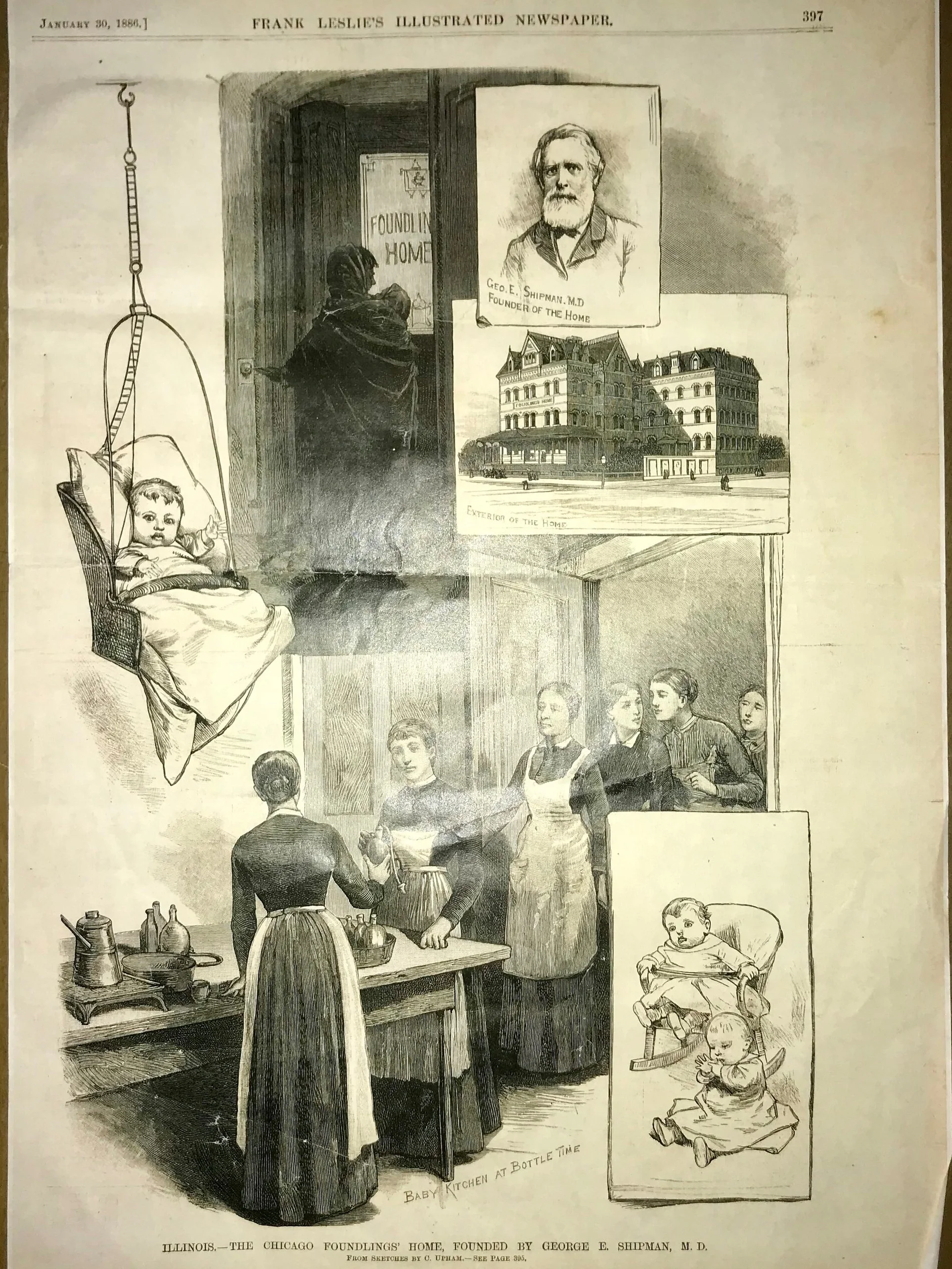
1886 Illustrated Newspaper featuring CFH
We came across Frank Leslie’s Illustrated Newspaper that featured founder Dr. George Shipman and the Foundlings Home.
January 30, 1886


Foster Care Awareness Month
SOS Children’s Villages Illinois + Foster Care Awareness Month
To learn more about becoming a Foster Parent with SOS Illinois, visit us at sosillinois.org/fpq
Did you know that May is Foster Care Awareness Month? SOS Children’s Villages Illinois highlights the needs to create a sense of community for foster kids and keeping siblings together. To read more, here is a link to SOS Children’s Villages Illinois CEO, Tim McCormick, speaking to Hinsdale Living Magazine in 2018 about the goals of SOS Illinois and how you can get involved. For those of you ready to dive right in, see below more information on the phase’s of becoming a foster parent at SOS Illinois.
Foster Care Facts (via American SPCC)
45% of foster children live in non-relative foster family homes.
32% of foster children live in relative foster family homes.
23% of foster children live in institutions, group homes, trial and pre-adoptive homes.
118,000 children and youth in America are waiting to be adopted.
On average, a child can spend almost 12 to 20 months in foster care.
10% of foster children spend more than 5 years in foster care.
26% of children entering foster care are under the age of one.
About 22% of youth in foster care are age 13 or older.
20,500 youth are emancipated from foster care without reunifying with their families, or being adopted.
Of youth who age out of foster care, 1/4 are incarcerated within 2 years and only 1/2 graduate from high school.
Children and adolescents with foster care experience are diagnosed with PTSD at twice the rate of U.S. war veterans.
RUSH Adolescent Family Center & the Foundlings Home
Introduction to how RUSH Adolescent Family Center started with the help of Chicago Foundlings Home.

The story of the Rush Adolescent Family Center didn’t actually begin in 1974. The foundation of what would become the AFC was laid in the mid 19th century with the establishment of Rush Hospital and the Chicago Foundlings Home. Both institutions were charted to serve the needs of Chicago’s growing population. The Rush Adolescent Family Center was established in 1974 with the signing of a historic agreement between the Rush Presbyterian St. Luke’s Medical Center and the Chicago Foundlings Home Foundation.
The Rush Adolescent Family Center was a bold experiment in using a multi-disciplinary approach in working with pregnant teens and not everyone was convinced it would be successful. The AFC staff was composed of doctors, nurse midwives, nurses, a social worker and support staff who took a holistic approach to providing prenatal care to low income pregnant teens.
One of the many innovations of the AFC program was it’s incorporation of social workers as an integral part of the treatment team providing counseling and prenatal education to the AFC’s teen patient population. The Adolescent Family Center began as a small unit on Rush’s Labor and Delivery floor, providing prenatal care, prenatal education, counseling and postpartum follow-up care to pregnant teens, most of whom lived on the Westside of Chicago. In the beginning most of the medical care was provided by nurse midwives under the supervision of Rush attending physicians. In conjunction with Rush nurses, nutritionist, social workers and physicians the program established a multi-disciplinary team concept that stressed a holistic approach to prenatal care.
What made the Adolescent Family Center so unique was that the program took the name family seriously. Patients weren’t just patients to AFC staff they were part of an extended clinic family and they were treated that way. Staff took a personal interest in the lives of their patients and their babies. One of the special ways that the AFC embodied the concept of family was through the Center’s annual Patient Christmas Party. The party was organized each year by AFC staff for Center patients and their families. The AFC Patient Christmas Party remained a holiday tradition for the next 30 years.
No history of the Adolescent Family Center would be complete without a tribute to the private foundations, the Rush Women’s Board, the Medical Center and the Illinois Departments of Public Health and Human Services who, over the years, have provided the necessary financial support to keep the Center operating and true to its mission of providing care regardless of the patient’s ability to pay. Number one on this list of financial supporters has to be the Chicago Foundlings Home.

Over the years the definition and needs of Chicago teens have changed dramatically and in response the programs and services offered by the Adolescent Family Center have also changed. Today the AFC:
Serves twice as many non-pregnant patients than pregnant patients
Serves patients from over 100 different zip codes within Chicago and its suburbs
Provides medical services to almost 1,000 patients each year
Provides testing and treatment for sexually transmitted infections to over 700 patients yearly
Provides health exams and STD testing for male patients
Provides community education to over 8,000 public school students each year.
Provides enrollment assistance for the Illinois Medicaid and Moms and Babies programs.
Serves young people up to age 25
As one of the original signatories on the agreement to create RUSH’s Adolescent Family Center, the Chicago Foundlings Home has provided essential funding and guidance to the Center throughout its 40 year history and will continue to do so!
**Coming Soon**
Although the physical location of Foundlings Home closed in 1971, we’ve partnered with organizations who bring our mission into the 20th and 21st centuries. To give adoptees and their families an idea of the incredible work that is still being done through CFH, we are featuring a blog to highlight each organization and their connection to Foundlings home and then tell stories from MercyWorks, New Beginnings, RUSH Adolescent Family Center, SOS Children’s Villages, and the Jane Addams College of Social Work.