
On the Front Lines of Violence Intervention

Two new studies at the Jane Addams Center for Social Policy and Research have focused on a long-neglected but essential aspect of community-based violence intervention programs: the people who work on the front lines.
Reducing community violence through prevention and interruption programs is not a new concept, and certainly not new to Chicago. For twenty years, the UIC School of Public Health was home to Cure Violence, a pioneering program that applied a public health approach to violence interruption and community safety. Now, at the Jane Addams Center for Social Policy and Research (Policy Center), two leading-edge studies are elucidating a formerly neglected aspect of violence prevention: the intervention workers themselves. Through the examination of the experiences, perspectives, and well-being of these essential front-line workers, these studies have elucidated factors that contribute to successful community-based responses to gun violence and have elevated the voices of people who put themselves at risk working in violence prevention.
“I know the streets and I know what’s been going on.
I can reach out to people with high risk. I have seen them grow up. I have been living in this community for years.
I have compassion for kids and want to show young women the right way.”
The People Who Do the Work
The majority of Acclivus staff are male and are predominantly Black or Latinx, and the CEO is an African-American male. The age of Acclivus staff ranges from 36 to 66, with a mean of 47. Thirteen of the staff members were formerly employed by Cure Violence, eight of whom were front-line intervention workers.
The staff live in and have strong connections to the communities and people they serve. They also have shared experiences with the people they are trying to reach; staff described their backgrounds as having been involved in gangs, on the wrong path, or a troublesome youth, and a little over two-thirds had been incarcerated. Those shared life experiences make them very dedicated to their work and they report a strong sense of having learned from their past experiences and wanting to help others. On the other hand, they also work long hours and speak of being on-call “24/7”.
The educational background of the staff is diverse, with the highest degree obtained ranging from GED to doctorate. For 40 percent of the staff, the highest degree was a GED or high school. Forty-six percent had an associate degree or some college, and 13 percent had a bachelor’s degree
or higher.
The staff report great pride in what they have achieved in their own lives, for example, buying a house or a car, completing a college degree, or seeing a child go to college. The importance of family is evident in their responses, with some reporting the grief of losing family or friends during the COVID-19 pandemic.
Doing the Work
In general, the staff view communication as key to their work, involving maintenance of a network of relationships with individuals and community organizations, team communications, effective communication in deescalation efforts, and communication of available supports and resources to individuals and families in the community.
“They understand the communities where the individuals come from and the dynamics of the situations. They truly understand the culture and without being judgmental provide them with valuable assistance.”
They see their work of connecting residents to resources or social services, or helping people find employment, as core to the promotion of community safety. Likewise, the public health aspect of the work is evident in the frequency with which staff speak about supporting the health or mental health of community members. This is especially true with the community outreach team.
The focus of the hospital response team is centered around deescalation and violence prevention after a shooting, and they often cite rapid response as key to deescalation. However, they also work to connect clients and their families to supportive services or resources.
The staff express great care for the communities in which they live and work, and for the individuals they serve. They also indicate a fundamentally trauma-informed approach in the way that they respect their clients’ individuality and avoid stigmatization or further traumatization.
“The goal is to prevent the gun shot or stabbing victim from being reinjured and prevent family members/friends from retaliating.
We help prevent violence; improve health outcomes; prevent domestic violence; address homelessness, and (improve) mental health. We feed the homeless. In our communities we do it all.”
Assessing Success
Acclivus staff view their efforts as important and successful, and attribute their connections to the community as key to that success. They are also aware of the importance of changing social norms about violence at both the individual and community levels.
The staff think highly of the organization and its leadership, as well as of the organization’s approach to violence prevention and interruption, and they see their efforts as essential and successful. However, many staff cited lack of resources and funding as a limitation on expansion of their services.
Community members and stakeholders also see the work as valuable, and view the street intervention workers as assets in the community. Ability to navigate and effectively communicate within the community was also cited as a particular strength of Acclivus staff.
“Having a fuller understanding of the people who succeed at this dangerous but necessary work may be helpful in replicating violence interruption in other communities or other cities,” observes Dr. Hairston. “And it also serves as a reminder that people from the community are often the heart of effective community-based responses to gun violence.”
Supporting the Wellness of Street Intervention Workers
“Our outreach workers have been caught in crossfires. I’ve seen it. I’ve seen them lose people, get attachments to participants that’s making strides, and then they ended up getting killed.”
Dr. Kathryn Bocanegra
Assistant Professor Kathryn Bocanegra describes street intervention work as a healing profession, helping to heal individuals and communities. “However, most people in healing professions have not been the patient; most trauma surgeons have not had a traumatic injury, or most therapists have not experienced mental illness,” she says. “Street intervention workers, on the other hand, are often wounded healers, healing from their own trauma as they accompany others in the process of redirecting and transforming their lives.”
Dr. Bocanegra’s recent study, Between a Bullet and Its Target, examined the primary occupational stressors experienced by street intervention workers (SIWs), the forms of trauma they are exposed to, and the existing organizational supports and best practices to support them in addressing this trauma. “We need to do everything possible to support front-line workers engaged in violence reduction practice. Their success can be measured in human lives,” she says. “They are doing this work with few resources available; It’s like trying to stop bullets with their bare hands.”
To better understand the range and impact of these traumatic experiences, Dr. Bocanegra and her team conducted in-depth, semi-structured interviews with SIWs and supervisors who provide services in Chicago neighborhoods that experience community violence. Following is a general overview of
the findings.
The Experience of Trauma
“I began this work while incarcerated. So, we began to do outreach in the space that we were in…so many nights of watching the news and seeing what was happening in the city that we loved.”
Most SIWs are system survivors and work within communities impacted by disinvestment and structural racism. Dr. Bocanegra found that trauma manifests itself within a longitudinal, ecological context in their lives and dynamically interacts with the regular exposure to trauma that occurs in community violence intervention. She also found that trauma exposure in street intervention work is much more expansive than originally conceived, and she describes shootings or homicides as just the tip of an iceberg. “SIWs are deeply engaged in victim services, they experience a high frequency of criminal-legal interface, and they may also experience forms of organizational trauma in their workplace,” she says.
The shared histories between SIWs and their clients also carry a number of risks, including increased potential for boundary confusion, violation, or countertransference; the projection of personal experiences onto clients; and increased vulnerability to burnout. “Just having been involved in the streets or been to prison does not make someone a wounded healer, and it does not make someone effective in street intervention work,” she explains. “Trauma recovery is the personal transformation that must take place, and how we think about trauma and understand it through existing clinical frameworks is complex.”
Dr. Bocanegra found existing clinical frameworks to be inadequate in describing the traumatic experience of SIWs, with most discourse using PTSD as the reference point for understanding symptoms. “PTSD and Complex PTSD are incomplete and inaccurate depictions of the trauma, which is ever-present and ongoing, and the problematic ‘symptoms’ we target in PTSD may be keeping SIWs alive,” she explains. “Problematizing hypervigilance and hyper-startle reactions is contradictory to the very instincts one needs to navigate environments with high rates of gun violence.” The study indicates that Continuous Traumatic Stress is the best clinical framework through which to understand the experiences of outreach workers, and it is from this framework that subsequent interventions should be designed.
“[Trauma training] helped me with some of my own trauma that I had, that I’ve experienced growing up and especially with doing this work and also had identified it through others too . . . So, yeah, it was definitely helpful.”
Organizations as Intervention Points
Dr. Bocanegra thinks it is imperative for nonprofit organizations to operationalize wellness by integrating it into onboarding and orientation, supervision, workload management, and ongoing training and professional development. Organizations employing SIWs can create safe spaces within the organization for the sharing of experiences and peer support. They can also help SIWs deal with past and ongoing traumatic experiences by providing psychoeducation or coping skills training.
“The organizations themselves play a very important role in maintaining an environment of safety and support,” she says. “By protecting the workers, they are building a more robust public health infrastructure, which has a long-term impact in the neighborhoods they serve.”
Click here for the full article.
Watch SOS Illinois 2nd Annual Women's Leadership Forum!
The SOS Children’s Villages Illinois’ 2nd Annual Women in Leadership Forum was hosted yesterday! We are excited to share this 90-minute dialogue that featured five fascinating women who represent companies and businesses cross the State of Illinois. The goal of the Forum is to hear the journey of women into leadership and consider strategies to improve opportunities for women.
Join us for the SOS Illinois Women in Leadership Forum
Celebrate Women's History Month with SOS Illinois 2nd Annual Women's Leadership Forum
Happy International Women's Day from Chicago Foundlings Home!
We're excited to celebrate all month! Join us and register for this engaging event hosted by one of our funding recipients!

The SOS Children’s Villages Illinois’ 2nd Annual Women in Leadership Forum is scheduled for Wednesday, March 23 at 11am CST. We are excited to share this 90-minute dialogue that will feature five fascinating women who represent companies and businesses across the State of Illinois. The goal of the Forum is to hear the journey of women into leadership and consider strategies to improve opportunities for women.
View this Event Online here!
Friends First Mentoring Matches Create Lifelong Friendships
Click here for the original article on the Mercy Home website.
January is National Mentoring Month, but we celebrate our mentoring matches all year long! Mentoring changes the lives of so many young people by providing them with needed support to grow and thrive. And through our Friends First program, which matches a child with a well-trained volunteer mentor, countless lives have been changed for both mentor and mentee.
Mentor John Reddington and his mentee, Malik, were matched four years ago and are still going strong! John became involved in Friends First when he was looking for a way to be involved in mentoring and a friend suggested Mercy Home’s program. After some research, he knew that it would be a great fit.
The first time John and Malik met, John remembers being very nervous, despite typically being a person who is comfortable stepping into new environments. Malik was nervous, too, but the initial meeting between John, Malik, Malik’s mother, and the Friends First coordinator went really well, John explained. The first outing John and Malik went on was to a DePaul basketball game.
“It was a really cool ice breaker,” John said. “It was something that was new for him that he had never done before.”

When they were driving home from the game, Malik told John that he had a lot of fun with him that day. And from then on, John said that their trust and comfort level has continued to build.
Throughout the years they’ve been together, they’ve done countless of fun activities, but they both enjoy spending time outdoors and being active. John noted that the peacefulness they experience hiking in the woods was such a different environment from the one Malik grew up in.
Their time together has also helped Malik face some of his fears. He used to be uncomfortable with swimming, but now he loves it. And he faced his fear of heights by trying rock climbing and ziplining. John explained that he is constantly trying to find activities that will give Malik new experiences.
“We built a really good trust,” John explained. “And a good rapport. It’s been a special relationship.”
John and Malik also enjoyed doing activities with John’s dog. So when his dog passed away last fall, both were devastated. But it was also an opportunity for Malik to be there for John. For Christmas, he got John a picture of his dog etched into glass. He also let John know that he was there to support him.
“I knew that I played that role in his life, but [this showed] the role he plays in my life and how he shows up,” John said. “I think obviously we’ve been close, but I think hard moments like that, it brought us even closer. We had a chance to talk about life and death and those moments.”
Malik has also opened up to John about many subjects, like family relationships and getting older. John said he’s glad he can be someone to listen in these situations and provide support. John has also gotten to know Malik’s family, and Malik’s brother has even joined on a few outings. They especially love their fall tradition of visiting a haunted house together.
Like everywhere else, the pandemic has provided some challenges, but John and Malik continued to make the best of things and grow their relationship. Though it was hard not being able to spend as much time together in person, John would occasionally drop off one of Malik’s favorites, Do-Rite Donuts, and they would talk outside with masks on and socially distant. They also texted and called each other to stay in touch.
John also said that Mercy Home has provided incredible support to Malik. When Malik was struggling in school, Katie Gunter, the manager of Friends First, was able to find him a tutor to help get him caught up. And because Malik only had an iPad to do his work on, Mercy Home was able to get him a computer so he would have an easier time getting his schoolwork done.
It’s a privilege in the sense that you have the chance to impact someone’s life in a positive way.
“I have so much love, appreciation, and respect for Mercy Home,” John said.
When reflecting on his time as a mentor, John highlighted the importance of the relationship he has built with Malik.
“It’s a privilege in the sense that you have the chance to impact someone’s life in a positive way,” he said.
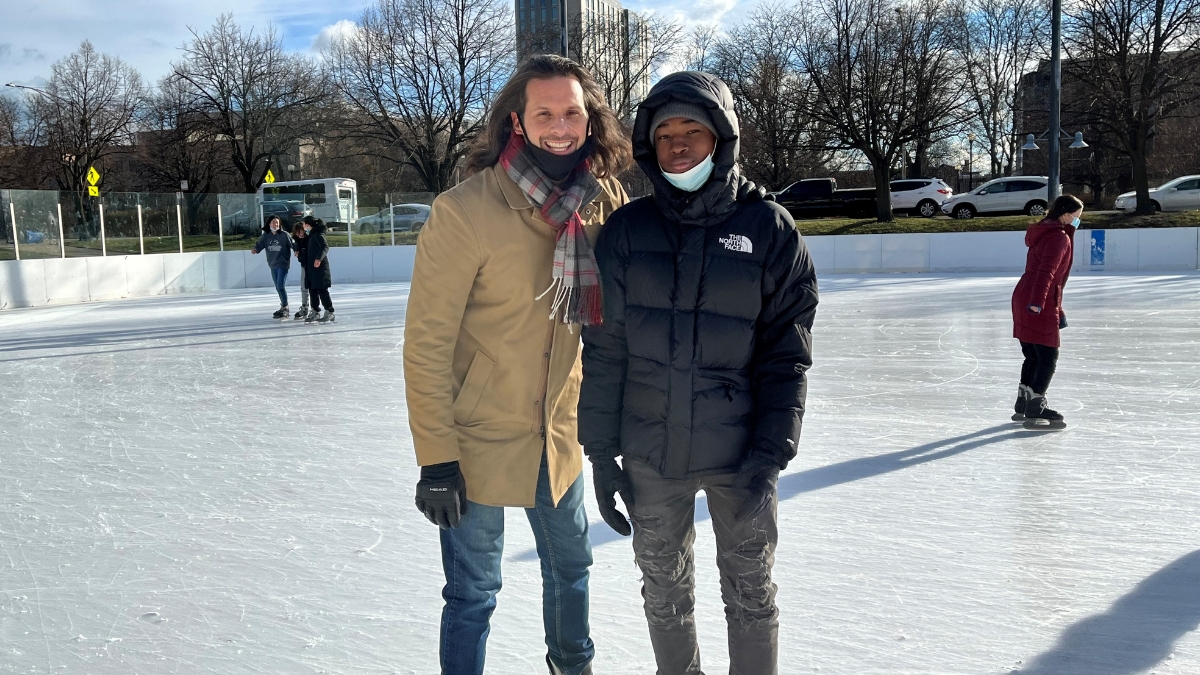
Malik also shared what makes his relationship with John so special.
“[I like] his personality and we have a lot in common,” he said. “He’s a very good person. [He’s helped me] to become more social and more mature. It’s easier to talk to people and [easier] being around people.”
And although John and Malik come from different backgrounds and have different experiences, they also have a lot of common.
“We both like to explore and do a lot of things,” Malik explained.
“When you first start spending time with people that have different backgrounds, different living experiences, come from different places … you noticed the differences,” John added. “They’re all around you. But the more time you spend together, you realize there are more similarities.”
And when John thinks back to that very first day he met Malik, and how nervous they both were, he’s filled with gratitude that he was willing to try something outside of his comfort zone.
“This is what it means to grow, to put yourself in uncomfortable situations,” he said. “I could have easily just not done this. But when you start these relationships because you’re growing, you’re learning, you’re meeting different people. And I think that’s the beauty of it, how much growth you have.”
Learn more about the Friends First program here.
A Message Of Remembrance Honoring MLK Day & Black History Month
This January, SOS Children’s Villages Illinois and its Racial Justice Committee shares a message of remembrance as it honors the legacy of Dr. Martin Luther King Jr. and recognizes the many individuals who have sacrificed to create a path forward so that Dr. King’s dream can be realized. To celebrate MLK Day and begin the celebrations for Black History Month, the Racial Justice Committee offered events and service projects for our children and families to learn from, take part in, and enjoy.

You can view the original post on the website of SOS Children’s Villages of Illinois.
Inspire our youth with a book this Black History Month
Celebrate Black History Month with SOS Illinois.

Annual Black History Month Book Drive
Hosted by SOS Children’s Villages of Illinois.
Check back in our event page next February, we look forward to celebrating with you!
Thank you for supporting this important project to inspire youth in foster care.
Interested in making this a company or volunteer project? Please let us know!
Contact Hope Burk at hburk@sosillinois.org.
Join us for Mercy Home's Brighter Together

Join us in kicking off the holiday season with this beloved Mercy Home tradition.
Mercy Home Tree Lighting Celebration
Join Mercy Home’s kids for the second year in a row as we ring in the Christmas season with a special, virtual tree lighting celebration!
Gather with us for a beloved Mercy Home tradition that will feature a message from Fr. Scott Donahue, special presentations from our young men and women, musical entertainment, silent auctions, raffles, and more. Hosted by Jim Williams, CBS2 Chicago.
Proceeds support the children of Mercy Home for Boys & Girls.
Date: November 18, 2021
Time: 7:00 P.M.
Place: Virtual Event
19th Annual Graduates' Luncheon Honoring Mercy Home for Boys & Girls' Class of 2021
Celebrate Mercy Home's Class of 2021!
Tuesday, June 8
11:45 am | Virtual Event
19th Annual Graduates' Luncheon
Honoring Mercy Home for Boys & Girls' Class of 2021
In the face of an especially challenging school year, Mercy Home's young people continue to work hard to build brighter futures. They know that reaching their academic goals is a critical step on the road to lifelong success.
That's why we come together every spring to encourage these determined young people while raising the resources we need to provide them life-changing educational opportunities. We invite you to join us in this celebration--please attend our virtual Graduates' Luncheon, June 8th at 11:45 am.
For the 19th year, we will hear their powerful stories of triumph over adversity while we congratulate them on their achievements. Like last year, we'll be gathering entirely online. But that just makes it easier for you to join us for a commencement unlike any other. Best of all, you can help us raise the support these young people need to build brighter futures.
This special 45-minute live-stream event will feature an address from one of our graduating young people and a keynote address by Angelique L. Richard, PhD, RN, CENP, Chief Nursing Officer, Rush University Medical Center and Rush University System for Health, Senior Vice President of Hospital Operations, Rush University Medical Center. All donations up to $100,000 will be matched.
If you are unable to attend, please consider supporting our young people's educations with a donation. All gifts will be matched up to $100,000.
NYT Opinion: For 50 Years, I Was Denied the Story of My Birth
All adoptees deserve better.
By Steve Inskeep
Mr. Inskeep, a co-host of NPR’s “Morning Edition” and “Up First,” is an adoptee and an adoptive father.
In 1968, a woman appeared for an interview at the Children’s Bureau, an adoption agency in Indianapolis. She was in her 20s and alone. A caseworker noted her name, which I am withholding for reasons that will become apparent, and her appearance: She was “a very attractive, sweet looking girl,” who seemed “to come from a good background” and was “intelligent.” She had “blue eyes and rather blonde hair,” though the woman said her hair was getting darker over time, like that of her parents.
Her reason for coming was obvious. She was around 40 weeks pregnant. She told a story that the caseworker wrote down and filed in a cabinet, where it would rest for decades unseen. The expectant mother said she had grown up in Eastern Kentucky’s mountains, then migrated north as a teenager to find work after her father died. She was an office worker in Ohio when she became pregnant by a man who wasn’t going to marry her. The most remarkable part of her story was this: When she knew she was about to give birth, she drove westward out of Ohio, stopping at Indianapolis only because it was the first big city she encountered. She checked into a motel and found an obstetrician, who took one look and sent her to the Children’s Bureau. She arranged to place the baby for adoption and gave birth the next day.
The baby was me. If she’d driven farther, I’d be a native of Chicago or St. Louis, but Indianapolis it was. Life is a journey, and I was born on a road trip. I spent 10 days in foster care before being adopted by my parents, Roland and Judith Inskeep, who deserve credit if I do any small good in the world.
My parents told me early that I was adopted, but that was all they knew. Indiana, like most states, practiced closed adoption, meaning birth families and adoptive families were allowed no identifying information about each other. Secrecy was considered best for all concerned. In recent decades, open adoption has been replacing this practice, but rules governing past adoptions change slowly, and I was barred from seeing my birth records. Everything I just told you about my biological parents was unknown to me growing up; they were such a blank that I could not even imagine what they might be like.
I accepted this until I became an adoptive parent in 2012 and a social worker suggested that my adopted daughter might want to know my story someday. She’s from China, and like many international adoptees, she also had no story of her biological family. So I requested my records from the State of Indiana and was denied. Next I called the Children’s Bureau, where a kind woman on the phone had my records in her hands, but was not allowed to share them.
It still didn’t bother me excessively until after 2018, when Indiana law changed. Many adoptees or biological families may now obtain records unless another party to the adoption previously objected. In 2019 the state and the Children’s Bureau sent me documents that gave my biological mother’s name, left my biological father’s name blank and labeled me “illegitimate.” On a hospital form someone had taken my right footprint, with my biological mother’s right thumbprint below it on the page.
Typed notes from the Children’s Bureau recorded a visit with my biological mother in the hospital. Asked how she felt, she cried. And when she went to the Children’s Bureau for follow-up meetings, she was clearly trying to hold herself together. A caseworker encouraged her to process her emotions, but she was “adept” at conversing with “seeming openness” while “maintaining a wall around her feelings.” For her final meeting, after shopping downtown, she wore “a pink sheer shirtwaist and heels,” with “a tiny waist,” as if she had never been pregnant. The one emotion she expressed was feeling “trapped” in Indianapolis. She was so desperate to sign the paperwork and leave town that she was half an hour early for her appointment. She planned to visit her family in Kentucky, but not to tell them of her experience: She’d been calling home without saying where she was.
It’s been nearly two years since I first read those documents, and I’m still not over it. Knowing that story has altered how I think about myself, and the seemingly simple question of where I’m from. It’s brought on a feeling of revelation, and also of anger. I’m not upset with my biological mother; it was moving to learn how she managed her predicament alone. Her decisions left me with the family that I needed — that I love. Nor am I unhappy with the Children’s Bureau, which did its duty by preserving my records. I am angry that for 50 years, my state denied me the story of how I came to live on this earth. Strangers hid part of me from myself.
While I now have the privilege of knowing my information, many people’s stories are still hidden. About 2 percent of U.S. residents — roughly six million people — are adoptees, according to the National Conference of State Legislatures. A majority were adopted domestically, with records frequently sealed, especially for older adoptees. Gregory Luce, a lawyer who tracks adoption laws, reports that only nine states allow adoptees unrestricted access to birth records. Indiana is among those that have begun to allow it under certain conditions, while 19 states and the District of Columbia still permit nothing without a court order. California and Florida remain closed; Texas surrenders a birth certificate only if you prove you already know what it says. If my biological mother had stopped in a different state back in 1968, I might know nothing today.
This spring, more than a dozen states are considering legislation for greater openness. Bills in Florida, Texas and Maryland would ensure every adoptee’s access to pre-adoption birth records. Proposals in other states, like Arizona, would affirm the rights of some adoptees but not others. The legislation is driven by activists who have lobbied state by state for decades. Many insist on equality: All adoptees have a right to the same records as everyone else.
Equality would end an information blackout that robs people of identity. Throughout life, I have met people who spent years searching for birth parents, complicating their struggles to come to terms with their past. While that was not my experience, I was never able to tell a doctor my family medical history when asked. It’s one of those little things that never bother you until it does. I attended college in Eastern Kentucky, living there for years without the slightest idea that my biological mother grew up there.
The people who blocked me from learning my past must have thought their motives were pure. Closed adoption began as “confidential” adoption in the early 20th century, enabling parents and children to avoid the stigma of illegitimacy. Records were sealed to all but people directly involved. In a further step, by midcentury, even parties to the adoption were cut out. Agencies offered adoptive parents a chance to raise children without fear of intrusion by biological parents, and biological parents a chance to start over.
But nobody asked if I wanted my identity hidden from me. Jessica Colin-Greene, writing in The Connecticut Law Review in 2017, observed that “access to information about one’s genetic background, heritage, and ancestry is a birthright denied only to adoptees.” An adoptee “is expected to honor a contract made over his or her body and without his or her consent.” Someone might argue that the state had to decide for me as a newborn — but the state’s original plan was to deny my identity for life, and even deny it to my children.
Should adoptees and biological families contact each other, after the law forbade it for so long? Not without mutual consent: It’s an intensely personal decision. But information alone is powerful. When Indiana finally made its records more accessible in 2018, so many people requested documents that state employees were overwhelmed. A 20-week backlog of requests built up and has persisted — a testament to how many human lives were affected. As records are opened, people’s privacy should be respected; that’s why I’m withholding my biological mother’s name and any details that might identify her. But my story is mine, and other adoptees have a right to recover theirs.
Steve Inskeep is a co-host of NPR’s “Morning Edition” and “Up First” and the author of “Imperfect Union: How Jessie and John Frémont Mapped the West, Invented Celebrity and Helped Cause the Civil War” and other books.
This article was originally published in the New York Times Op-Ed Section on March 26, 2021. You can view the article on their site here.
New Expertise for Social Justice: Professors at Jane Addams School of Social Work
Faculty who joined the college in Fall 2020 brought a diverse range of expertise to support the mission of advancing social and racial justice, and health equity for marginalized populations .
Expertise in community mental health and violence prevention in urban communities

Kathryn Bocanegra
Assistant Professor
Through over 15 years of experience in community mental health and violence prevention, Kathryn Bocanegra has seen firsthand the trauma experienced by street intervention workers . They not only witness violence, they have personal experiences with violence . They often work in the same communities where they have experienced harm or previously harmed others, she says . “This takes a toll on their physical and emotional health, and their relationships . It even impacts their ability to effectively do their job.
”Now, under a grant from the Robert R . McCormick Foundation, she is working to understand the effect of trauma exposure among street intervention workers and to identify supports that mitigate the effects of this trauma in their personal and professional lives . Through interviews with 35 intervention workers in several Chicago neighborhoods, as well as with their supervisors, she will gain insights into best practices for supporting these workers .
“Trauma-informed and healing-centered approaches to violence prevention work have become commonplace over the last five years” says Bocanegra . “Individuals employed in street intervention practice are trained in these frameworks to help them work more effectively with clients . It is important, however, for the same approach to be used within organizations to support street intervention staff in the difficult work they do .” At the completion of the study in Winter 2021 she will have manualized the findings into training modules that assist organizations in creating supportive work environments for street intervention staff, as well as mechanisms to develop their leadership skills and career trajectories.
Bocanegra is also collaborating with scholars at other institutions with a common goal of strengthening street intervention work as one of the primary measures of public safety in urban communities .“Street intervention staff are leaders in developing more robust infrastructures for community safety,” she say . “Their expertise, often born out of personal suffering, should be promoted at a larger scale as our city develops multifaceted strategies to reduce violence and heal from historical and structural violence .”
Expertise in substance use among sexual minority men, syndemics and intersectionality

Walter Gómez
Assistant Professor.
A recent research focus for Walter Gómez has been methamphetamine use among sexual minority men, with data gathered primarily in the San Francisco area, where he worked before joining JACSW . “My study initially focused on how sex and sexual compulsivity played a role in these mens’ lives, and how it impacted recovery efforts for them,” he says . “But I also looked at the effects of interventions themselves . Methamphetamine is one of the few high-risk, high-priority areas that do not have an approved biomedical intervention for recovery . So I’m interested in seeing if and how we can ramp up behavioral interventions to be more effective .”
Gómez sees both intersectionality and syndemics as central to his work .He explains syndemics as involving multiple co-occurring synergistic, adverse events that impact health and well-being in particular communities or groups . “You may be dealing with people impacted by substance use, but who are also understood to have higher rates of depression, sexual abuse, trauma, poverty, incarceration, and other factors,” he says . “You can’t just look at addiction as a siloed phenomenon, you have to look at how all of these other adverse events and experiences impact their trajectory .
”He explains intersectionality as entailing demographic traits; describing people who are multiply oppressed and may carry multiple identities . In the case of his study the population was HIV positive men with histories of substance use . “But it’s essential to examine all the additional ways they experience oppression or marginalization,” he says .Gómez notes that methamphetamine use research with sexual minority men is more focused in coastal metropolitan centers such as New York, Miami, San Francisco or Los Angeles, and that in the Midwest meth tends to be more used by the straight white population . “Here, opioids are the focus, so it’s going to require adaptation of my work to the local environment,” he says, “but the goal is to continue this kind of research to address the needs of these communities in Chicago .”
Expertise in childhood trauma and well-being, and community partnerships

Michelle-Ann Rhoden Neita
Assistant Professor
Michelle-Ann Rhoden Neita is deeply committed to community-based practice, with a special interest in grassroots and faith-based organizations . “It’s so important for service provision to be based in the community for accessibility,” she says, adding, “I favor smaller grassroots organizations because they provide needed community services with limited resources and support compared to larger organizations.
”Her prior clinical experience is grounded in providing therapy for children and families involved in the foster care system . She has witnessed the trauma and adversity these children can experience, and the long-term impact it may have later in life . “With these children, we’re often talking about psychological and intergenerational trauma, exposure to chronic violence, and abuse . The impact can depend on how chronic the trauma is, that is the intensity and the frequency,” she says . “And there is a spectrum of outcomes ranging from altering how you view yourself and how you view the world, to developing some PTSD symptoms to full PTSD .”
Michelle-Ann explains that people who experience chronic, cumulative trauma are in a heightened state of “fight, flight or freeze .” This raises cortisol levels which impacts them physiologically, producing chronic health issues, but also emotionally and behaviorally, which increases the risk for impulsivity and other self-regulation problems . “I’m very interested in these physiological and biological responses to trauma,” she says, “and advancing trauma-informed care approaches .
”She also wants to examine trauma and epigenetics, and this lies at the heart of her intended research agenda at JACSW . “Studies have shown that chronic trauma can actually affect the functioning of one’s genes, which has implications for physical and psychological health, and this may be intergenerational,” she says . “I want to study changes in the epigenetics of people in the child welfare and justice systems, to gain a greater understanding of the full impact of trauma in these populations .”
Expertise in school social work and equity building

Make it stand out
Whatever it is, the way you tell your story online can make all the difference.
Lecturer Chastity Owens: Expertise in school social work and equity building
Chastity Owens spent 10 years serving as a school-based practitioner in both a charter school and in UI Health school-based health centers in Chicago . She now leverages that cumulative experience as a lecturer in the college’s School Social Work Specialization, including the Post-MSW PEL (Professional Educator’s License) Certificate Program.
At this moment in U.S . history, she thinks it’s important for social workers to foster conversations around justice and equity in their school communities . “We should be focusing on issues around equity and elevating the voices of the youth, and finding ways to come together and be a united front,” she says . “But we also need to understand and listen to the diversity of perspectives within our schools .
”To facilitate this, she suggests the creation of spaces where students can share their thoughts and feelings about their community and what they can do to make things right .“But the most important thing is to listen, and see what’s going on with our students in schools,” she says .“We might have our own ideas about what’s going on with racial justice, but it’s important to especially focus on where the students are at and where they’re coming from . And then, from a human development perspective, assist them in making connections and working on how they can contribute to making things better in their communities .
”Owens says it’s essential that school practitioners see parents and families as key stakeholders, observing that too often parents are viewed as being merely extensions of the students . “Parents really need to be engaged as individuals and key contributors in the conversation about equity . The more we can connect with and engage parents, the more holistic education can be,” she says . “The more students can see their parents and teachers and school administrators interacting and working together, the healthier it is for their own development .”
She also thinks social workers will play a key role in the return to classroom instruction after remote learning . “As schools go back to in-person learning, there will be more need for school social workers because students will need to process and heal from the trauma of COVID-19, and re-learn how to interact with each other again,” Owens says . “Who better to do that than social workers?”
This article was printed in the UIC Jane Addams School of Social Work Spring 2021 Edition of “Affirmations”.