
New Expertise for Social Justice: Professors at Jane Addams School of Social Work
Faculty who joined the college in Fall 2020 brought a diverse range of expertise to support the mission of advancing social and racial justice, and health equity for marginalized populations .
Expertise in community mental health and violence prevention in urban communities

Kathryn Bocanegra
Assistant Professor
Through over 15 years of experience in community mental health and violence prevention, Kathryn Bocanegra has seen firsthand the trauma experienced by street intervention workers . They not only witness violence, they have personal experiences with violence . They often work in the same communities where they have experienced harm or previously harmed others, she says . “This takes a toll on their physical and emotional health, and their relationships . It even impacts their ability to effectively do their job.
”Now, under a grant from the Robert R . McCormick Foundation, she is working to understand the effect of trauma exposure among street intervention workers and to identify supports that mitigate the effects of this trauma in their personal and professional lives . Through interviews with 35 intervention workers in several Chicago neighborhoods, as well as with their supervisors, she will gain insights into best practices for supporting these workers .
“Trauma-informed and healing-centered approaches to violence prevention work have become commonplace over the last five years” says Bocanegra . “Individuals employed in street intervention practice are trained in these frameworks to help them work more effectively with clients . It is important, however, for the same approach to be used within organizations to support street intervention staff in the difficult work they do .” At the completion of the study in Winter 2021 she will have manualized the findings into training modules that assist organizations in creating supportive work environments for street intervention staff, as well as mechanisms to develop their leadership skills and career trajectories.
Bocanegra is also collaborating with scholars at other institutions with a common goal of strengthening street intervention work as one of the primary measures of public safety in urban communities .“Street intervention staff are leaders in developing more robust infrastructures for community safety,” she say . “Their expertise, often born out of personal suffering, should be promoted at a larger scale as our city develops multifaceted strategies to reduce violence and heal from historical and structural violence .”
Expertise in substance use among sexual minority men, syndemics and intersectionality

Walter Gómez
Assistant Professor.
A recent research focus for Walter Gómez has been methamphetamine use among sexual minority men, with data gathered primarily in the San Francisco area, where he worked before joining JACSW . “My study initially focused on how sex and sexual compulsivity played a role in these mens’ lives, and how it impacted recovery efforts for them,” he says . “But I also looked at the effects of interventions themselves . Methamphetamine is one of the few high-risk, high-priority areas that do not have an approved biomedical intervention for recovery . So I’m interested in seeing if and how we can ramp up behavioral interventions to be more effective .”
Gómez sees both intersectionality and syndemics as central to his work .He explains syndemics as involving multiple co-occurring synergistic, adverse events that impact health and well-being in particular communities or groups . “You may be dealing with people impacted by substance use, but who are also understood to have higher rates of depression, sexual abuse, trauma, poverty, incarceration, and other factors,” he says . “You can’t just look at addiction as a siloed phenomenon, you have to look at how all of these other adverse events and experiences impact their trajectory .
”He explains intersectionality as entailing demographic traits; describing people who are multiply oppressed and may carry multiple identities . In the case of his study the population was HIV positive men with histories of substance use . “But it’s essential to examine all the additional ways they experience oppression or marginalization,” he says .Gómez notes that methamphetamine use research with sexual minority men is more focused in coastal metropolitan centers such as New York, Miami, San Francisco or Los Angeles, and that in the Midwest meth tends to be more used by the straight white population . “Here, opioids are the focus, so it’s going to require adaptation of my work to the local environment,” he says, “but the goal is to continue this kind of research to address the needs of these communities in Chicago .”
Expertise in childhood trauma and well-being, and community partnerships

Michelle-Ann Rhoden Neita
Assistant Professor
Michelle-Ann Rhoden Neita is deeply committed to community-based practice, with a special interest in grassroots and faith-based organizations . “It’s so important for service provision to be based in the community for accessibility,” she says, adding, “I favor smaller grassroots organizations because they provide needed community services with limited resources and support compared to larger organizations.
”Her prior clinical experience is grounded in providing therapy for children and families involved in the foster care system . She has witnessed the trauma and adversity these children can experience, and the long-term impact it may have later in life . “With these children, we’re often talking about psychological and intergenerational trauma, exposure to chronic violence, and abuse . The impact can depend on how chronic the trauma is, that is the intensity and the frequency,” she says . “And there is a spectrum of outcomes ranging from altering how you view yourself and how you view the world, to developing some PTSD symptoms to full PTSD .”
Michelle-Ann explains that people who experience chronic, cumulative trauma are in a heightened state of “fight, flight or freeze .” This raises cortisol levels which impacts them physiologically, producing chronic health issues, but also emotionally and behaviorally, which increases the risk for impulsivity and other self-regulation problems . “I’m very interested in these physiological and biological responses to trauma,” she says, “and advancing trauma-informed care approaches .
”She also wants to examine trauma and epigenetics, and this lies at the heart of her intended research agenda at JACSW . “Studies have shown that chronic trauma can actually affect the functioning of one’s genes, which has implications for physical and psychological health, and this may be intergenerational,” she says . “I want to study changes in the epigenetics of people in the child welfare and justice systems, to gain a greater understanding of the full impact of trauma in these populations .”
Expertise in school social work and equity building

Make it stand out
Whatever it is, the way you tell your story online can make all the difference.
Lecturer Chastity Owens: Expertise in school social work and equity building
Chastity Owens spent 10 years serving as a school-based practitioner in both a charter school and in UI Health school-based health centers in Chicago . She now leverages that cumulative experience as a lecturer in the college’s School Social Work Specialization, including the Post-MSW PEL (Professional Educator’s License) Certificate Program.
At this moment in U.S . history, she thinks it’s important for social workers to foster conversations around justice and equity in their school communities . “We should be focusing on issues around equity and elevating the voices of the youth, and finding ways to come together and be a united front,” she says . “But we also need to understand and listen to the diversity of perspectives within our schools .
”To facilitate this, she suggests the creation of spaces where students can share their thoughts and feelings about their community and what they can do to make things right .“But the most important thing is to listen, and see what’s going on with our students in schools,” she says .“We might have our own ideas about what’s going on with racial justice, but it’s important to especially focus on where the students are at and where they’re coming from . And then, from a human development perspective, assist them in making connections and working on how they can contribute to making things better in their communities .
”Owens says it’s essential that school practitioners see parents and families as key stakeholders, observing that too often parents are viewed as being merely extensions of the students . “Parents really need to be engaged as individuals and key contributors in the conversation about equity . The more we can connect with and engage parents, the more holistic education can be,” she says . “The more students can see their parents and teachers and school administrators interacting and working together, the healthier it is for their own development .”
She also thinks social workers will play a key role in the return to classroom instruction after remote learning . “As schools go back to in-person learning, there will be more need for school social workers because students will need to process and heal from the trauma of COVID-19, and re-learn how to interact with each other again,” Owens says . “Who better to do that than social workers?”
This article was printed in the UIC Jane Addams School of Social Work Spring 2021 Edition of “Affirmations”.
Answering the Call for Racial Justice

During the last year, many events converged to bring renewed urgency to combating racism and white supremacy. The College responded by placing race and racial justice at the center of many activities.
“What is racial justice? A better starting point might be to talk about racial injustice, identify all the places injustice exists,” says Henrika McCoy, JACSW Associate Professor and Interim Associate Dean for Academic Affairs and Student Services . “As Dr . Martin Luther King Jr . wrote from his jail cell in Birmingham, ‘Injustice anywhere is a threat to justice everywhere.’
”The list of racial disparities, inequities and injustices in the United States is long, at this point almost a litany that should be well-known to scholars and practitioners in social work: the overrepresentation of Black families in the child welfare system; the racially disproportionate use of detention and other punitive practices in schools; the underrepresentation of Black students in higher education; racial disparities in criminal justice, from policing and sentencing, to parole and post-prison; and the disproportionate use of force and violence by police in communities of color. “The list just goes on . It can be overwhelming to think about,” McCoy says . “But we have to. We must be willing to talk about injustice and inequity, and shine a light on racism everywhere it exists .
”Advancing racial justice is a core part of the College’s mission and informs much of the work done at the College and its Centers .Concomitantly, elevating the voices of people who live in marginalized communities of color and including their lived experiences in research and advocacy is central to that work .The past year, however, brought a renewed call to action for combating racism and ending discrimination, with people across the country and around the world pouring onto the streets to express outrage and call for an end to white supremacy . The College has answered that call in a number of very meaningful ways .
Giving Voice to Experiences of Racism and White Supremacy
Dr . McCoy has been studying experiences of violent victimization among young Black men, including both familial, interpersonal and structural violence . Central to her research were interviews conducted with such young men, gathering their experiences and unique perspectives in their own words . More recently, however, her focus turned to other forms of structural and institutional racism, especially as they exist in social work and in higher education .In the last year, she has published powerful and incisive articles on these topics, in both the academic and popular press . McCoy is quick to point out that the experiences she has written about are nothing new, and that she is expressing thoughts and ideas many people have but may not feel secure or safe enough to share . “America is in a state of heightened awareness of race and racism, and social workers are being asked to interrogate white supremacy in their own practice,” she says .“I think there’s a general feeling that we have a window of time in which we can speak more directly to these issues, so that’s what I’ve been doing .We need to take advantage of this because, if history is any indicator, the window will probably close as quickly as it opened .”As made clear in her article What Do You Call a Black Woman With a PhD? A N*****, as well as in a recent panel the College hosted with the American Society of Criminology (see below), Black academics have no difficulty citing personal experiences of racism in academia . “No matter who you are as a Black person, in my case a Black woman, you don’t have the power to say anything about it . Because even when you do, your words don’t matter as much as the other person’s,” she observes .Racism can extend beyond personal interactions to the core of social work practice, where certain attitudes, no matter how well-intentioned, can manifest white supremacy . “Traditionally, social workers see themselves as people who want to help the world . I remember my first day as a student in practice class, and the instructor asked how many of us were there because we wanted to help people . We all raised our hand,” McCoy says with a chuckle . “She said to us, ‘Put your hands down, that is not what social workers do!’ Social work is not about you being a savior .”McCoy thinks there has long been an underlying sense among many well-meaning social workers, though certainly not all, that the point of their practice is to be heroes or saviors, bringing exogenous knowledge into the community and speaking on behalf of people . “I’m increasingly seeing this, social workers assuming they know what the problems are, what people in the community need or want,” McCoy observes . “But they don’t live in the community . They’re latching onto what they think is important because they heard one community member say it . That’s not good enough . Broad involvement from community members must underlie our understanding of what’s true, as well as our practice as social workers and advocates .”
McCoy hopes that her recent scholarship, op-eds and opinion pieces will have an impact as a form of macro social work advocacy, but she has no illusions about the resistance or discomfort some people experience with these issues. “The primary goal in all of my work is to give voice to people who don’t have the same opportunity to share their thoughts and experiences . In my recent articles, I hope that my voice has been representative of people who are perhaps unable to share their own experiences,” she says . “And I want to make sure that paternalistic or racist attitudes in social work are pushed aside, and that we foster an authentic community-based ethos in our practice. Social workers are not saviors; the community leads,we follow .”
Addressing Racism with the American Society of Criminology
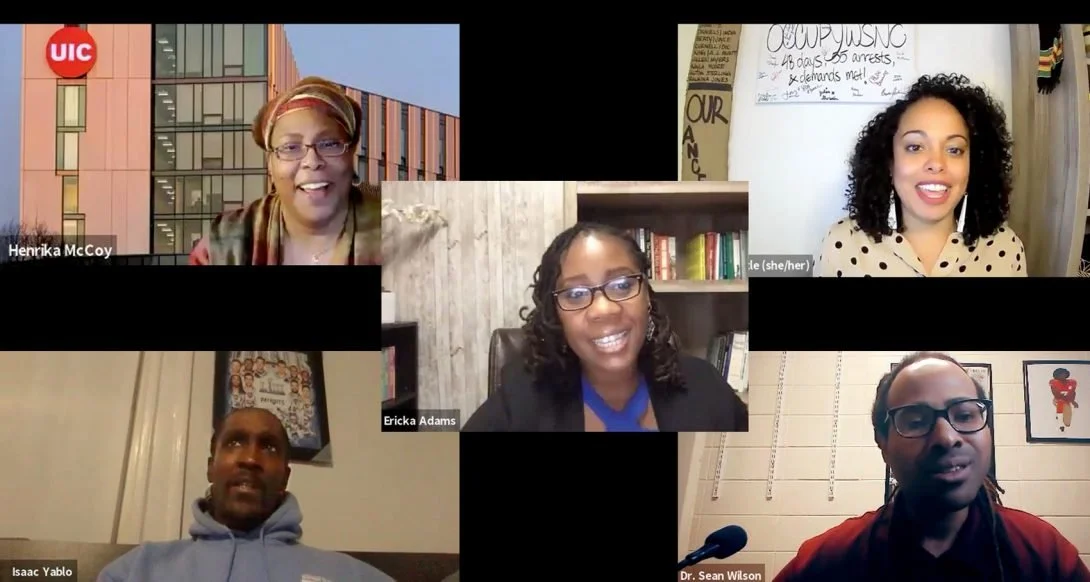
A screenshot from Activism Among Academics: Creating Change from “The Ivory” showing the five panelists, including JACSW associate professor Henrika McCoy (top left).
Beginning in the Fall of 2020 and continuing through Spring 2021, the College has partnered with The American Society of Criminology, Division on People of Color and Crime, to produce a series of webinars exploring aspects of race and activism in academia. The first such webinar was Activism Among Academics: Creating Change from “The Ivory” and featured a panel of four Black academics at different stages of their careers . The panelists discussed racial disparities and personal experiences with discrimination in academia, as well as their decisions to engage in anti-racist activism despite potential damage to their academic careers.
Interim Associate Dean Henrika McCoy served as a panelist, drawing on the ideas and experiences she has presented in her own scholarship . “Calling out racism can have professional ramifications, and Black tenure-track academics have to make a potentially difficult decision . Your academic career can be dependent on other people who have power over you,” she says . “I’m very fortunate that Dean Hairston has been so supportive; I’m sure I would not have felt as free to say such things in other environments. But it is very important to share these experiences and ideas because people need to know the truth .”
The second webinar, Black Lives Matter vs. Far Right Extremism: Protests, Movements, and Riots, featured Black academics and activists who addressed the rise in white supremacism and how Black activists and their allies can combat this threat to justice and equity . This panel included JACSW doctoral candidate Janaé Bonsu, who has been a prominent and powerful voice for racial justice in Chicago.
Engaging with Race, Racism and Trauma in School Settings
The 2020 JACSW Training Institute for School Social Work Professionals, titled Mental Health Strategies for School Re-entry for Students & Staff Amidst Societal Uncertainty and hosted virtually in August, was a response to what Clinical Associate Professor Annette Johnson, MSW ’03, describes as the “double pandemic of COVID-19 and racial injustice .” Johnson is Chair of the college’s specialization in School Social Work and also spearheads the annual training institute.
“I was concerned that there was so much information about the concrete, preventative aspects of the pandemic, such as wearing protective equipment and social distancing, but very little was being said about people’s emotional response to COVID-19,” she says . “Communities of color have been so disproportionately affected by the pandemic, then in the midst of that we saw the killing of George Floyd and the social unrest that followed . All of these things can be traumatic and impact mental health, especially among vulnerable young people . I knew we had to do something .”
Johnson searched the literature but found very little that would help address the issue, so she assembled a team of practitioners and administrators from Illinois schools . The team examined ways of addressing the social and emotional impact of the double pandemic on students, teachers and staff . “We began to think about what this would look like when in-class instruction resumed, what information school practitioners would need to convey to administrators, teachers and students,” she says .
The institute drew nearly 180 participants from across the country and featured Sharon A . Hoover, PhD, Co-Director of the National Center for School Mental Health, who provided expertise in school practice and the mental health needs of students . “The webinar was very well-received, and all participants received a comprehensive resource guide that was developed by our team,” Johnson says . “But I knew there was more work to do, that we had not exhausted the topic of addressing race and racism .”
In January of 2021, a virtual Booster Session was hosted to continue that work . Titled Expanding Equity: Addressing Racism in Our Work, the discussion was led by three outstanding school-based practitioners, Jenny Andersen, LCSW, Dawn Deacon Maroscher, School Psychologist, and Joe Alger LCSW . The webinar prepared school practitioners to engage in difficult conversations about race and equity . The discussion challenged attendees to alter their paradigm on how best to engage in discourse on race, structural inequalities, oppression, and the invisibility of privilege .
Johnson notes that as remote learning has continued longer than anticipated, practitioners have had no knowledge of how students have been impacted by social isolation amidst the ongoing double pandemic . “In addition to addressing the trauma we wanted to continue building on the themes of racism and equity, and get helping practitioners to think reflectively and introspectively about their own perspectives, and how they address equity and racism,” she says .“School social workers need to be acutely aware of their own potential biases, how they see and respond to students of color .
”The presenters also spoke of “the talk”, a conversation that African American parents have with their children . “I think some people may not know what that talk is . But I don’t think you can approach an African American parent who hasn’t had that talk with their children, particularly if the children are male,” says Johnson .“What we’ve accomplished in this session is to open this conversation for practitioners, get it on their radar . And we will continue building on this foundation, and are looking to continue this important work at future institutes .”
The Injustice of Trauma and Violence Among Young Black Males

Olga Osby, DSW
Special Guest Panelist
The focus of the Karen J . Honig Memorial Lecture has always been children, especially those in urban settings and/or involved with the child welfare or foster care systems. However, given the nation’s renewed sense of urgency for racial justice, the theme for this year’s virtual lecture was Strategies to Address Trauma, Anxiety and Violence Interruption Among Black Males, a topic that is crucial for the advancement of racial justice in marginalized communities. For the lecture, a panel was assembled to bring expertise in trauma-informed clinical practice with youth and families, community violence, and violence intervention and prevention, in order to fully explore the theme.
Panel moderator Associate Professor Henrika McCoy has herself researched violent victimization experienced among young Black men . “Young men in marginalized Black communities may experience so many forms of violence and trauma, which have so many ramifications for their mental and physical health and well-being, as well as their progress in our society,” she says . “The importance of addressing these experiences and traumas cannot be overstated . This is why we asked Dr . Olga Osby to present as our special guest panelist .”
Olga Osby, DSW, who has received many honors and accolades throughout her career, is currently co-managing partner of Clean Slate Behavioral Health Solutions, LLC, which provides trauma-informed training to health care, law enforcement, social service and other professionals, and trauma-informed counseling to children, families and communities . It was this range of experience that made her particularly well-suited to this panel.
The other panelists were JACSW faculty members, each bringing essential knowledge and experience to inform this discussion . Assistant Professor Kathryn Bocanegra has over fifteen years of experience in community mental health and violence prevention, and is advancing survivor-centric reforms to criminal justice processes and developing community-based models of public safety. Dr . Joseph Strickland brought 25 years’ experience in community-based advocacy and programs for affordable housing, community development, ex-offenders, youth, and community health, and has a research focus of how Black males bounce back from the traumas of incarceration and street violence .
“Addressing racial injustice has long been a pillar of the college’s mission and the work of its faculty, whether the injustice occurs in schools, the criminal justice system or other environments . It is affirming to see social workers and social work educators joining these discussions, and calling for justice with an energy and interest seldom seen before,” says JACSW Dean Creasie Finney Hairston . “Yet we know the magnitude of the task that lies before us, the work we have still to do, on a number of fronts . To help meet that challenge, the college will continue to foster these sorts of dialogues – in a spirit of openness and inclusivity, even if uncomfortable at times – in the knowledge that we share a common goal of achieving justice and equity for all people . Working together, we can make a difference for individuals, families and communities of color .”
This article was printed in the UIC Jane Addams School of Social Work Spring 2021 Edition of “Affirmations”.