
Most American Adoptees Can’t Access Their Birth Certificates. That Could Soon Change.

Even though the practice of lifelong anonymity
has no legal standing, it has dominated adoptions since 1935.
In 1963, when Carole Whitehead was an unwed 18-year-old mother in New York, she placed her baby up for adoption. This had always been the plan, but she asked for the record to be open so that one day, if her son was interested, he would be able to contact her.
“Don’t tell me I want confidentiality,” Whitehead remembers telling hospital staff. “I don’t want confidentiality.” But the process was unclear, and she felt forced into handing over her child to an adoption agency without being informed of her legal rights. “I wasn’t promised confidentiality,” says Whitehead, who is now an adoptee rights advocate. “We never asked for it.”
Staff at Louise Wise Adoption Agency handled the surrender and placement of Whitehead’s child and likely told her that, as a birth mother, there would be “confidentiality” no matter what she said was her preference. This assurance was routine at the time.
Indeed many birth mothers report they didn’t choose and weren’t legally guaranteed lifelong “anonymity” from surrendered sons and indeed, many birth mothers report they didn’t choose and weren’t legally guaranteed lifelong anonymity from surrendered sons and daughters, says Gregory Luce, a lawyer and founder of the Adoptee Rights Law Center, based in Minneapolis. As a result, many of those who support the status quo believe the original birth certificates of adult adoptees should remain sealed forever, and assume there is lifelong “anonymity” for birth parents. Adoption agencies, lawyers, or others in the industry may have offered birth parents short-term “confidentiality” or “privacy” to protect them from anyone finding out about the pregnancy, but any suggestion or insinuation that birth parent “anonymity” could be maintained forever is incorrect.
Even though the practice of lifelong anonymity has no legal standing, it has dominated adoptions since 1935. Until that point, most U.S.- born adoptees had unrestricted access to the records of their birth. After 1935, adoption agencies offered “confidential” or “closed” adoptions, in which there’s no contact between the birth and adoptive families while the adoptee is a minor. But adoptees of all ages, in states where the right to access their original birth certificate has not been restored to them as adults, continue to have the option to petition the court for a copy of this document.
States then started to seal original birth certificates once the adoption was finalized and issued an amended version to appear as if the adoptive parents had given birth to their adopted son or daughter. This began a clandestine process that politicians and supporters first presented as a way to protect the child from any perceived stigma of being adopted and later would present as a way to protect adoptive families from birth mothers who might meddle in their newly created or expanded families.
For most adoptees seeking to unseal their records, this practice has resulted in a difficult and costly journey should they ever attempt to get a copy of their original birth certificate. With no federal law dictating access to adoption records, the matter was left up to the states, where there is a patchwork of vastly different laws, none of which are based on any unifying legal precedent. Today, in statehouses around the country, a diverse and growing movement of adoptees, birth mothers, adoptive parents, and others — who see restoring unrestricted access to records of adult adoptees’ birth, like their original birth certificate, as an essential civil right — is pushing lawmakers to consider measures to enact what is known as “clean” adoption reform.
While no one knows for sure how many Americans are adoptees, the University of Oregon’s Adoption History Project estimates there are 5 million Americans alive today who are adoptees. In the 1970s, adoption rights activists attempted to change laws and make it possible for adoptees to regain unrestricted access to vital records, including original birth certificates. Activists argued it was important for them to understand their biological history, and the difficulty in accessing birth certificates was burdensome and discriminatory. No other American is required to get a court order to access this basic document.
The movement took hold in some states but not others. In nine states, adult adoptees can apply for and obtain their original birth certificate without any restrictions. Twenty-two states, including South Carolina, limit access through various measures, such as allowing a birth parent to deny the release of an original birth certificate or redacting information on the document (even though there are no laws promising anonymity to birth parents). In New York, 18 other states, and Washington, DC, where these records remain sealed, the only option for adoptees is to petition the court, which can be costly and has no guarantee. Whether a court petition is successful or not, adoptee rights activists say the process fails to recognize the basic right to access vital personal records of one’s own birth, and is inherently discriminatory.
All over the country, there are various efforts to restore the rights of adoptees. In states where laws that restore access have been challenged, courts have rejected arguments that birth parents have a constitutional right to privacy or anonymity in the context of the adoptee’s own birth record. New York, Texas, and Florida are all looking at restoring access to original birth certificates of adult adoptees to varying degrees, ranging from “access with restrictions” to “unrestricted access.”
In Florida, for instance, a bill was filed this year that adoptee rights advocates say is badly flawed because it makes access to original birth certificates dependent on birth parent involvement. If HB597 passes, adoptees will have to apply through the Florida Adoption Reunion Registry and connect with at least one birth parent before being allowed to apply for a copy of their original birth certificate. Currently, adult adoptees in the Sunshine State who want an original birth certificate must first be in reunion with a birth parent who consents to the release or obtain a court order.
Some adoptee rights advocates refer to Florida’s bill as “dirty,” because an adult adoptee’s access to their original birth certificate is restricted. In contrast, New York recently introduced a “clean” bill that will restore the rights of adoptees to get a copy of their birth certificate when they turn 18 If it is passed beginning January 15 2020 adult adoptees will have the same level of access to their birth certificate when they turn 18. If it is passed, beginning January 15, 2020, adult adoptees will have the same level of access to their birth certificates that non-adopted individuals may take for granted.
Even with more than 80 Assembly co-sponsors, and top adoptee rights groups like the American Adoption Congress, the National Center on Adoption and Permanency, and the North American Council on Adoptable Children supporting the measure, there has still been opposition. Birth mothers and elected officials who see the mothers’ right to privacy as paramount—though lifelong anonymity from surrendered sons and daughters was not legally guaranteed—have tried to prevent the legislation from passing.
“This issue shouldn’t be about anyone or anything else other than an overdue recognition of basic human rights,” says Tim Monti Wohlpart, a New York adoptee who serves as the National Legislative Chair, and New York state representative, for the American Adoption Congress, where he helped cement a formal legislative policy for “clean” reform. He also started a grassroots petition to advance the New York bill. He attributes any lingering opposition to the legislation to fear, and suggests that while some adult adoptees may prefer not to request a copy of their original birth certificate or records, they should still have a right to access them if they ever changed their mind. “New York does not simply have a policy of sealed records, but also a culture of secrecy,” he says. “The remedy is adoptee equal rights.” If the law is changed, each adoptee would have a range of options, “from no action, to retaining a birth certificate for their personal files, to completing a search” for their family members.
Luce, from the Adoptee Rights Law Center, points out another potential problem for those who oppose legislation for unrestricted access to adult adoptees’ original birth certificates. He says no promise of anonymity could legally have been made because there was never a guarantee the child would actually be adopted. In those cases, the adoptee would always have access to their records, or that if a judge believes there is cause to do it, courts can unseal adoption records. Luce, an adoptee, knows this process all too well. He successfully petitioned a court for his original birth certificate in Washington, DC, where he was born in 1965 and adopted at a week old. But he’s now challenging the redaction of his birth father’s name on the document because his birth father didn’t give consent. Luce says he already knows this information from his birth mother, with whom he had met before her death.
Only during the appellate process are these issues sufficiently narrowed, demonstrating, according to Luce, the distinction between “all this emotional stuff” involving reunions, but “about the record itself.”
This difference in state laws can compound the frustrations experienced by adoptees who must work with multiple state agencies. Erica Babino, the former national legislative chair for the American Adoption Congress, was born 55 years ago in New York but was adopted in Texas. When she was 25, she tried to gain access to her original birth records, a process that lasted for 25 years. On one visit to New York, Babino sobbed while a social worker sat inches from her with a file that contained her birth records but did not permit her to see them. She managed to find her birth family, but the records in New York remain inaccessible to her.
“There’s absolutely no reason why an adult cannot make a decision about their own lives and to be able to have their original birth certificate just like every other American,” she said.
“There’s absolutely no reason why an adult cannot make a decision about their own lives and to be able to have their original birth certificate just like every other American.”
For those who believe that the records should be sealed, protecting mothers, who may have not wanted their past revealed is often cited as the main reason. Advocates for women who have experienced traumatic, unwanted pregnancies, like author Kathleen Hoy Foley, say there are dangers in exposing these women unilaterally. In her written statement to the New Jersey legislature when an open-records law was being debated in 2011—the measure eventually passed three years later—she stated: “All women in hiding are petrified of the betrayal of such private and personal information…and all the same and anguish such exposure carries with it.”
A small number of opponents, mainly Catholic groups, argue that some birth mothers may have opted for abortion rather than adoption if they thought their identities would be revealed. The American Adoption Congress says this has not been the case. “The data reveals that if access has had any effect on adoptions and abortions, it’s been to increase adoptions and decrease abortions,” the group noted.
In Texas, one state senator has successfully blocked open access laws repeatedly for other reasons. Donna Campbell, a physician and adoptive mother, claims adult adoptees may want to find their birth mother for “financial reasons.” Shawna Hodgson, co-founder of the Houston-based Equality4Adoptees organization, has worked with adoptees throughout the country to bring an open-access measure to the Texas legislature and says that despite overwhelming support, similar bills filed in 2015 and 2017 were eventually killed by Campbell, a close political ally of Senate President Lt. Gov. Dan Patrick.
Historically, the National Council for Adoption has opposed the types of unrestricted access currently proposed across the country, and for the past few years hasn’t waded into the debate. But today, the nearly 40-year-old organization says it supports legislation that balances the needs of adult adoptees and their birth parents. Its president and an adoptive father himself, Chuck Johnson said the organization backs programs that use trained “confidential intermediaries” to discreetly contact birth parents or adoptees to see if they want to reunite, and leaves open the option for birth parents to decide whether they want to be contacted by an adoptee. “We support people who want to be contacted and allow ways to make that happen,” he said.
Being unable to access these records has often led adoptees to use social media and DNA testing services for answers. But advocates say this doesn’t replace access to original birth certificates. Adult adoptees who are not able to obtain a copy of their own original birth certificate may also be denied driver’s licenses and other government identity documents.
Carole Whitehead is 74 years old and works as a cancer registrar—a data information specialist for cancer patients in Plainview, New York. She has been involved with Unsealed Initiative, New York’s largest lobby for adoptee rights, for years. She never had access to her son’s records. But in 1985, with the help of a private investigator, she found Paul Dinberg, in Long Island. He was living only five miles away from where she lived at the time. When she drove up for their first meeting, he was sitting on the stoop in front of his house. “I waited 22 years for this,” Whitehead remembers telling her son during their emotional reunion. “I told him that I was his mother.”
Since then, Whitehead has remained in contact with her son, even attending his wedding with her husband and her two other children. Dinberg is now 54 and lives in Oregon with his two daughters and a stepdaughter. “He calls me Mom,” she said. “We’re family.”
Please click this link for the original article from Mother Jones.
Copyright © 2020 Mother Jones and the Foundation for National Progress. All Rights Reserved.
Upgraded SOS Children's Villages Illinois Website!
SOS Children’s Villages Illinois is excited to announce the launch of our upgraded website. The fresh site – conceptualized, designed, and launched in partnership with the digital agency, ArtVersion – offers a user-forward experience with a clean, sleek design, as well as elements that allow for interactive and vibrant viewing during desktop, tablet, and mobile browsing.
The concept behind the site is to move from a semi-responsive site to an adaptable, energetic resource hub that keeps visitors in touch with the lives and stories of those at the very core of our mission, the children and families served across our four Villages and sites.
“Every so often we have the opportunity to work with an organization of such importance and we are honored and thrilled that we can contribute and influence brand visuals and messaging the same way they impact the community,” shared Erin Lentz, Director of Design at Art Version.
“The new design was a strategic collaborative effort to clearly illustrate SOS Children’s Villages Illinois’ mission visually and contextually. We thoroughly enjoyed working with the SOS Illinois Team. Our cross-disciplinary creative team works closely through a highly collaborative process to ensure the best product is delivered to the client to meet their goals. We are proud to be recognized for the work that drives us.”
Users have come to expect an optimized user experience as a basic requirement, and it’s now become a prerequisite implementation strategy across all platforms and devices. The newly optimized site, focused on the user experience, recognizes the growing need to keep an increasingly web-savvy world informed, invested, and involved with the inner workings of SOS Illinois.
Among an array of new interactive elements and resources, three unique features will allow users to gain in-depth awareness of our brand, look inside our decades-long commitment to youth and families, and learn how to invest in the future of foster care.
At the heart of our new website is our revised blog feature, “Our Stories”, which aims to educate our friends and supporters on the many facets that bring SOS Illinois to life.
From details on signature events and fundraising efforts, to interviews with current Foster Parents and SOS Illinois Alum, to updated information on the ever-changing landscape of foster care, “Our Stories” amplifies the voice of our agency and offers calls-to-action, praise for our partners, and opportunities to get more engaged with the communities we serve. Plus, “Our Stories” shares a landing page with other media content, such as Press Releases, Newsletters, and Annual Reports. That way, you’ll always stay on top of SOS Illinois updates!
Inspired by “Our Stories” and interested in seeing how far we’ve come? Don’t forget to check out our new interactive timeline which traces back the founding of SOS Illinois over 25 years ago and further back to its roots in Imst, Austria exactly 70 years ago!
One of the most frequent inquiries SOS Illinois receives is requests for information about becoming a professional Foster Parent at one of our three Village communities in Chicago and Lockport. This position, which sits at the center of our Village Model of Care, involves ten, unique phases of interviewing, hands-on training, and licensure to ensure that each candidate and our community share a mutual fit. As such, it is more necessary than ever to have a website that can house all the details.
On our Foster Parenting page, users can dive into videos, lists, sliders, blog posts, and other interactive tools to learn more about each step between filling out an application and moving into one of our Villages as a Foster Parent. The site even includes a detailed Frequently Asked Questions page for some of the most common questions we receive about serving in our community.
Looking to get in contact with a member of our team to chat about how this position may be a good fit for you? Filling out our quick Foster Parenting Questionnaire is one of the fastest ways to get connected today!
The success of our community and our legacy of care is only made possible with the support of our donors, partners, and friends. With our updated Giving page, investing in SOS Illinois has never been easier.
With online philanthropy growing each year, we know how important it is for you to be able to invest online. Offering a dozen different options for giving, our interactive Giving page highlights twelve key ways that donors can support the next generation of leaders, innovators, and creators. From joining our growing list of monthly Dream Makers, to offering gifts in tribute to a loved one, to hosting your own fundraiser or giving drive, this new page showcases just a sample of opportunities available to those looking to invest in SOS Illinois. And as always, your information is kept safe and secure, making online giving the quickest way to create an impact on children and families at SOS Illinois.
Looking for a way to give back that isn’t offered on our website? Let us know by contacting us at info@sosillinois.org or 312-372-8200 and ask for our Advancement Team.
Each time a new visitor browses our website, your investment grows. By spreading awareness about SOS Illinois, you are helping to ensure that the children and families we serve have their voices and needs heard for years to come. Share our updated site on your social media page, with your company’s community engagement department, or with friends and family interested in supporting at-risk youth. By getting others informed, involved, and invested, you are helping us build the future of foster care. Visit us today – sosillinois.org.
Special Note:
ArtVersion has submitted our site to awwwards.com — which is a site dedicated to awards that recognize the talent and effort of the best web designers, developers, and agencies in the world. In the coming days, we will share a link to online voting. We encourage you to vote to increase our chance of getting an “Award winning site”!
A View from the MercyWorks Program

By Mosie Duhe
There’s a zigzagged crack in the plastic that bears witness to a night five months ago. One of the teenage boys I work with cursed and yelled, spilling the drawers of his plastic desk organizer onto the floor, throwing its skeleton at the walls. He was new here. So was I. In the conversation that followed, he and I sat heaped beside each other on his bedroom floor. My life is a mess, he whispered, debating whether or not to trust me. What am I going to do? Lifting plastic shards from the carpet, I began to snap them into place, rebuilding the broken structure. We’ll put the pieces back together, I told him, even if they fall apart again.
It was my first metaphor at work.
Since then, I’ve seen the metaphors littered everywhere, little images and analogies peering out of the chaos with predictable charm.
There’s the dirt caked on my hands from fetching rebounds on a warm January morning. One of the teenage boys stomps on the ground, berating himself for missed shots, symbols of mistakes his parents won’t let him forget. In the gray parking-lot slush, I chase down every ball he can’t make, dance with him on the pavement when he finally hits one. There are always more chances, I promise.
And there’s the Saturday morning ritual of cookie baking with a teenage boy who can’t go home. At least this place can smell like home. Every week, I wash the dishes, laugh at the flour on our clothes, and test each buttery treat, complimenting the chef. But almost as often, there’s no patience for the recipe, no comfort in the taste. Sometimes, the temptation of the streets seems just a little bit sweeter. Still, my job is to meet him at the kitchen table whenever he returns. To sit beside the boy who just wants to make something good and needs a person to be proud of it.
I believed in metaphors before I moved to Chicago. Believed in the beauty of broken plastic, muddied hands, and kitchen-table healing. And I’ve learned, admittedly, that this is a language all its own. A language of obvious cliché that only hopes to make sense of blatant disorder. I still believe in the metaphors, but I’ve learned that pretty words are more limited than I thought. They won’t ever sum up these richly complicated lives, despite their tendency to try.
“We are called to walk alongside each other and everyone else we encounter, from salsa-eating twenty-somethings to Jenga-playing teenage boys.”
Sometimes, on long nights at work—good and bad—when I race to find wooden blocks for one more game of Jenga or when a chair is upended and launched across the room, I catch a glimpse of the carpet. The striped and checkered patterns that match those in my own apartment. The same carpet that my community and I tread on in our bare feet. Stand on during tearful hugs and joyful embraces. Kneel down on in fits of laughter. Clean salsa off of after late night snacking. Rest helplessly on, lamenting that we have no idea what we’re going to do with our lives. The same carpet we sometimes even fall asleep on.
Of course, this too is a metaphor. In July, when the sixteen of us moved our belongings onto the basic carpet floor, we all hoped to carry one thing: the belief of a common ground. We might not know what we’re going to do with our lives and we can’t trust words to say what we’re already doing, but our fundamental vocation is as simple as a stupid metaphor about a boring old carpet. We are called to walk alongside each other and everyone else we encounter, from salsa-eating twenty-somethings to Jenga-playing teenage boys. Because the best therapy we can actually claim to know is presence—sitting amidst the mess, catching every rebound, tasting both sugar and surrender. At the very least, we can believe in that.
SOS Illinois - Ground Breaks at Roosevelt Square Community Center
Ground Breaks at Roosevelt Square Community Center
On June 11, SOS Illinois gathered Roosevelt Square Community Center funders, civic leaders, SOS Illinois Board Members, community advocates, staff, children, and families at 13th Street and Blue Island Avenue for a groundbreaking ceremony to mark the beginning of construction for the project. Roosevelt Square Community Center funders held shovels decorated by children as they broke ground on land that will soon provide much-needed programs and services to children and families in the care of SOS Illinois, as well as to community residents living in nearby neighborhoods.
Funders, Board Members, community partners, and friends gather to break ground.
The Roosevelt Square Community Center
This center, an 11,000 square foot space, will serve the children and families at our Roosevelt Square Village and surrounding communities. Programs will include academic, therapeutic, social, and recreational support; multi-use spaces for community member to connect to public resources and engage in training, activities, and events; as well as a signature culinary kitchen providing food and nutrition education, and jobs-skills training for the hospitality industry. In addition to the over one hundred children and families cared for by SOS Illinois, more than 5,000 people from the surrounding neighborhoods will be served by the center.
Voices of the Community
SOS Illinois CEO, Tim McCormick, thanked attendees for joining the organization at the future site of the community center. He started the event by sharing, “We all can make a difference by bringing ourselves together to make a difference.” With that, he introduced “Chicago Fire” Actor, David Eigenberg, who reiterated this notion, offering in remarks, “It is the essence of being human: the reaching out, and sharing with each other, bringing each one of us along to the next step, and learning and teaching.”
SOS Illinois CEO, Tim McCormick, welcomes guests and introduces the multiple definitions of “groundbreaking” fitting to our gathering.
SOS Illinois assembled an array of community voices who shared the impact the center would have on their lives. Community voices included: Elizabeth Hope, SOS Illinois Foster Parent; Karen Felix, SOS Illinois Program Director for the Roosevelt Square Village; Mary Baggett, ABLA President; Raymond Wilson, SOS Illinois Child Welfare Specialist; Michelle Morris, SOS Illinois Alumnus; and Ted Selogie – Swissôtel Chicago General Manager. Each spoke to the immense change this center will bring to the community.
Juan Moreno, President and Founder of JGMA and Community Center Architect, spoke of the impossibility of discussing the subject of this groundbreaking without making reference to his mother for her inspiration for a better life, and starting an architecture firm, “for the purpose of making a difference in people’s lives.” Moreno continued, “SOS [Illinois], they have a legacy, not just for their buildings, but buildings that make a difference in people’s lives, buildings that instigate change . . . so this center is going to break ground in many different ways.”
Tim thanked our Board of Directors for their leadership and dedication to the organization. Tim first recognized former Board President, Don Biernacki, who led the Board during the opening of the Roosevelt Square Village homes and helped guide the foundation of the Community Center project. Tim then introduced current SOS Illinois Board President, Jim Wolfe, who spoke of the collective effort of partners, community leaders, individuals, and our Board leadership. He further remarked, “This community has welcomed us, and we look forward to offering the residents a place that can be the hub of family reunification, academic, social, civic, and recreational activities.”
Also recognized at the event was the Chicago Housing Authority (CHA) for their support of our Village and the center. CHA CEO Eugene Jones, Jr. said, “CHA will continue to fulfill its commitment across this beautiful City . . . to provide more opportunities and affordable housing, and that’s what we are going to do with our community partners.”
Tim then thanked our elected officials for their support with the project and introduced 25th Ward Alderman Byron-Sigcho Lopez who shared a personal story of when he came to the community, “I was seventeen years old, a teenager, without a family, so I know the importance of having support systems, to have organizations like SOS [Illinois], to have the beautiful community around us, to make sure our children, our future, have a chance . . . The fact that we have so many people around us that are eager to work together to tackle the many challenges we have as a city is encouraging.”
28th Ward Alderman Jason Ervin followed, sharing, “While we may be divided by Loomis, by wards, this is still one community; and so we want everyone to participate in the things that are going on in both our wards. I think overall [this benefits] the community residents and that is the way it is supposed to be.”
The notion of a community being drawn together through the construction of this center was reiterated in our partners who have supported the Community Center project from the very beginning. Tim introduced Senior Vice President and Chief Marketing Officer at Wintrust, Matt Doubleday, who shared, “[SOS Illinois] is building communities and strengthening families, and providing children with all the tools and the environment they need to be successful. On the surface this sounds like a pretty easy thing to do, but their execution of it is what makes this really exceptional; and this is something that all of us, regardless of what our roles are in the community or with our businesses, can learn from.”
Zaidy Cardenas, Executive Director of Maestro Cares Foundation, offers thoughtful remarks on our partnership for the Roosevelt Square Community Center.
Tim then introduced Zaidy Cardenas, Executive Director of Maestro Cares Foundation. Zaidy shared, “Maestro Cares Foundation has partnered with SOS Children’s Villages Illinois because we believe in their mission to create stable loving families . . . Both foundations care deeply for the children we serve. And the construction of this new facility here in Chicago demonstrates our dedication to the children and our commitment to providing healthy and safe environments to live, learn, and play. Together we are changing lives and building dreams.”
Raphael Rodriguez with Goya Foods was pleased to offer a few remarks to close out our speaking component. “At Goya, we believe in bringing people together, and we usually do it through food; and this is what we will do again this time. We are very happy to be a part of this project.”
The Groundbreaking Ceremony
Following the ceremony remarks, SOS Illinois gathered an array of supporters to break ground at the site. Tim shared that the shovels for the event were specially made for each of our partners by the children at our Roosevelt Square Village. On every shovel, there was a different drawing depicting a service or program that will make the community center so important to our families and the surrounding community, such as financial education, therapeutic services, computer labs, the culinary kitchen, and more. SOS Illinois was delighted to offer these shovels as a keepsake to each participant for their care and dedication to our mission and this project.
Gathered for the photo were: Ted Selogie, Swissôtel Chicago; Mike Sabal, S. Mechanical; David Eigenberg, Actor, “Chicago Fire”; Colin Samson, Norman Mechanical; Rama Dandamudi, SOS Illinois Board Member, Snaidero Chicago; Bert Brandt, Lendlease; Frank Gurtz, Gurtz Electric; Alderman Jason Ervin, 28th Ward; Raphael Rodriguez, Goya Foods; Eugene Jones, Jr., CHA; Henry Cardenas, Maestro Cares Foundation; Tim McCormick, SOS Illinois; Jim Wolfe, SOS Illinois Board President and Knight Engineering; Matt Doubleday, Wintrust; Mary Baggett, ALBA President; Juan Moreno, JGMA; Alderman Byron Sigcho-Lopez, 25th Ward; Joe and Cheryl Skender, Skender Foundation; Don Biernacki, SOS Illinois Board Member, Former Board President and Related Midwest; Dave Hoffman, SOS Illinois Board Member & Project Manager; Delphine Rankin, SOS Illinois; Michelle Morris, SOS Illinois Alumnus; Devin Cronin, All-Tech; and Dan Heyn, Sub-Zero.
SOS Illinois supporter and “Chicago Fire” Actor, David Eigenberg, stops for a photo with the shovel created for him.
Before guests enjoyed refreshments, as well as a culinary demonstration offered by our corporate partner, Swissôtel Chicago and Chef Dan McGee, together, the group dug their shovels into the earth where only months from now a state-of-the-art community center will provide groundbreaking services. As one, our supporters, leaders, Board Members, staff, children, and families moved the dirt, thus raising their voices to share that as a united community, together, we are breaking new ground.
Chef Dan McGee from Swissôtel Chicago instructs youth in our care on how to carefully pipe whipped cream onto individual-sized Strawberry Shortcakes.
Ways to Support the Community Center Project
Through the generous commitment of time, resources, and financial support of many, SOS Illinois is determined to raise the necessary investments to build the Community Center and provide a beacon for the Village residents and surrounding neighborhoods. For ways to invest or learn more about the Community Center, visit here.
Learn more about the RUSH Adolescent Family Center
Rush’s Adolescent Family Center, which opened in 1974, aims to reduce teen pregnancy through education, quality care for those who get pregnant, and helping expecting adolescents and new mothers become productive adults.
Chicago Foundlings Home is proud to support the work at AFC that continues to drive our mission of helping expectant mothers and their babies.
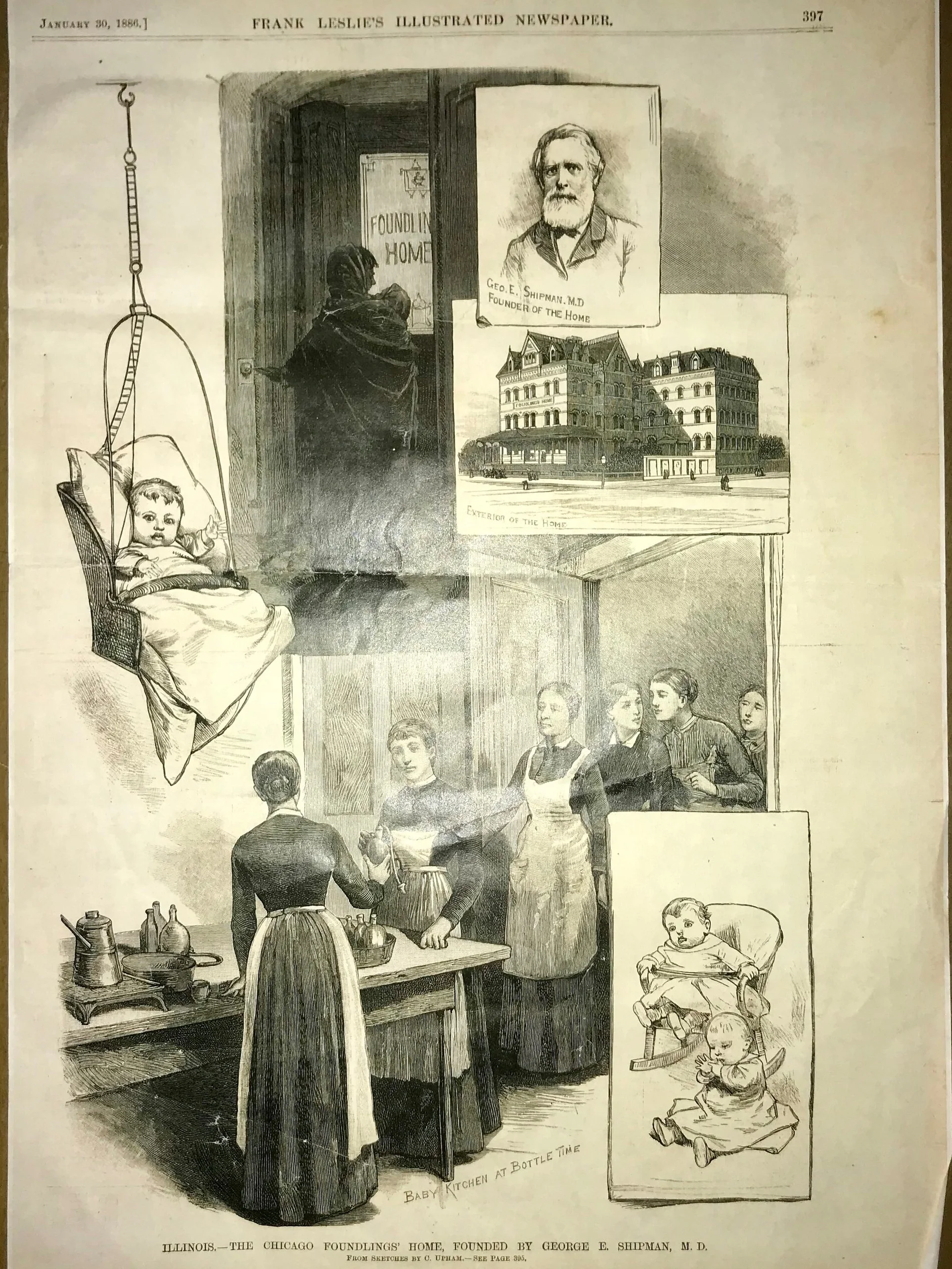
1886 Illustrated Newspaper featuring CFH
We came across Frank Leslie’s Illustrated Newspaper that featured founder Dr. George Shipman and the Foundlings Home.
January 30, 1886


RUSH Adolescent Family Center & the Foundlings Home
Introduction to how RUSH Adolescent Family Center started with the help of Chicago Foundlings Home.

The story of the Rush Adolescent Family Center didn’t actually begin in 1974. The foundation of what would become the AFC was laid in the mid 19th century with the establishment of Rush Hospital and the Chicago Foundlings Home. Both institutions were charted to serve the needs of Chicago’s growing population. The Rush Adolescent Family Center was established in 1974 with the signing of a historic agreement between the Rush Presbyterian St. Luke’s Medical Center and the Chicago Foundlings Home Foundation.
The Rush Adolescent Family Center was a bold experiment in using a multi-disciplinary approach in working with pregnant teens and not everyone was convinced it would be successful. The AFC staff was composed of doctors, nurse midwives, nurses, a social worker and support staff who took a holistic approach to providing prenatal care to low income pregnant teens.
One of the many innovations of the AFC program was it’s incorporation of social workers as an integral part of the treatment team providing counseling and prenatal education to the AFC’s teen patient population. The Adolescent Family Center began as a small unit on Rush’s Labor and Delivery floor, providing prenatal care, prenatal education, counseling and postpartum follow-up care to pregnant teens, most of whom lived on the Westside of Chicago. In the beginning most of the medical care was provided by nurse midwives under the supervision of Rush attending physicians. In conjunction with Rush nurses, nutritionist, social workers and physicians the program established a multi-disciplinary team concept that stressed a holistic approach to prenatal care.
What made the Adolescent Family Center so unique was that the program took the name family seriously. Patients weren’t just patients to AFC staff they were part of an extended clinic family and they were treated that way. Staff took a personal interest in the lives of their patients and their babies. One of the special ways that the AFC embodied the concept of family was through the Center’s annual Patient Christmas Party. The party was organized each year by AFC staff for Center patients and their families. The AFC Patient Christmas Party remained a holiday tradition for the next 30 years.
No history of the Adolescent Family Center would be complete without a tribute to the private foundations, the Rush Women’s Board, the Medical Center and the Illinois Departments of Public Health and Human Services who, over the years, have provided the necessary financial support to keep the Center operating and true to its mission of providing care regardless of the patient’s ability to pay. Number one on this list of financial supporters has to be the Chicago Foundlings Home.

Over the years the definition and needs of Chicago teens have changed dramatically and in response the programs and services offered by the Adolescent Family Center have also changed. Today the AFC:
Serves twice as many non-pregnant patients than pregnant patients
Serves patients from over 100 different zip codes within Chicago and its suburbs
Provides medical services to almost 1,000 patients each year
Provides testing and treatment for sexually transmitted infections to over 700 patients yearly
Provides health exams and STD testing for male patients
Provides community education to over 8,000 public school students each year.
Provides enrollment assistance for the Illinois Medicaid and Moms and Babies programs.
Serves young people up to age 25
As one of the original signatories on the agreement to create RUSH’s Adolescent Family Center, the Chicago Foundlings Home has provided essential funding and guidance to the Center throughout its 40 year history and will continue to do so!
**Coming Soon**
Although the physical location of Foundlings Home closed in 1971, we’ve partnered with organizations who bring our mission into the 20th and 21st centuries. To give adoptees and their families an idea of the incredible work that is still being done through CFH, we are featuring a blog to highlight each organization and their connection to Foundlings home and then tell stories from MercyWorks, New Beginnings, RUSH Adolescent Family Center, SOS Children’s Villages, and the Jane Addams College of Social Work.